arXiv:2406.18604v1 Announce Type: new
Abstract: In this work, we investigated a most general isotropic charged fluid solution for the Buchdahl model via a two-step method in $mathscr{F}(Q)$-gravity framework for the first time. In this context, a linear function of the form $mathscr{F}(Q)=zeta_1 Q+zeta_2$ and a particular transformation is used to solve the Einstein-Maxwell Equations (EMEs) employing the Buchdahl ansatz: $ e^{Upsilon(r)}=frac{mu(1+lambda r^2)}{mu+lambda r^2}$, where $zeta_1$, $zeta_2$, $lambda$ and $mu$ are constant parameters. The Schwarzschild de Sitter~(AdS) exterior solution is joined to the interior solution at the boundary to determine the constant parameters. It should be emphasized that, for a given transformation, the Buchdahl ansatz only offers a mathematically feasible solution in the context of electric charge, where pressure and density are maximum at the center and decrease monotonically towards the boundary when $0In this work, the authors investigate a general isotropic charged fluid solution for the Buchdahl model using the $mathscr{F}(Q)$-gravity framework. They propose a linear function and a particular transformation to solve the Einstein-Maxwell Equations (EMEs) with the Buchdahl ansatz. The constant parameters in the ansatz are determined by joining the exterior and interior solutions at the boundary.
The conclusions of this work are as follows:
The authors successfully find a mathematically feasible solution for the Buchdahl model in the context of an electrically charged fluid.
The proposed linear function and transformation provide a two-step method for solving the EMEs in $mathscr{F}(Q)$-gravity.
The solution exhibits isotropy and monotonic decrease of pressure and density from the center towards the boundary.
Future Roadmap
Building on the findings of this work, several opportunities and challenges lie on the horizon:
1. Further exploration of $mathscr{F}(Q)$-gravity:
Investigate other possible functions $mathscr{F}(Q)$ to expand the understanding of the Buchdahl model in the context of charged fluids.
Explore the implications of different transformations on the solution and the physical properties of the fluid.
Extend the study to other gravity models and compare the results with those obtained in $mathscr{F}(Q)$-gravity.
2. Numerical analysis and simulations:
Perform numerical simulations to study the behavior and stability of the proposed solution under various conditions.
Investigate the effects of different parameters, such as the charge and mass of the fluid, on the solution.
Explore the possibility of observational tests and comparisons with experimental data.
3. Generalization and applications:
Extend the study to anisotropic fluid solutions and investigate their properties using the $mathscr{F}(Q)$-gravity framework.
Explore cosmological implications and potential applications of the solution in astrophysics and cosmology.
Investigate the possibility of using the solution to model other physical systems, such as neutron stars or black holes.
Overall, the findings of this work provide a foundation for further research in the field of charged fluid solutions in the Buchdahl model using $mathscr{F}(Q)$-gravity. By exploring additional functions, performing numerical simulations, and generalizing the results, researchers can deepen our understanding of the physical properties and applications of this model.
In this article, the authors discuss the importance of predicting the minimum operating voltage ($V_{min}$) of chips for improving manufacturing testing flow, as well as ensuring the long-term reliability and safety of in-field systems. They highlight the limitations of current $V_{min}$ prediction methods, which often provide only point estimates and require additional techniques for constructing prediction confidence intervals.
Current Limitations in $V_{min}$ Prediction
The authors point out that existing techniques for $V_{min}$ prediction either rely on certain distributional assumptions or fail to provide coverage guarantees in their region predictions. This poses a challenge as uncertainties caused by different sources of variations need to be accounted for in order to construct reliable prediction intervals.
This limitation is problematic as manufacturers and system designers require accurate and reliable $V_{min}$ predictions to ensure that their chips operate within safety limits. Without confidence intervals, they lack a clear understanding of the potential range of $V_{min}$ values and are unable to make informed decisions to optimize chip performance.
A Novel Approach: Distribution-Free $V_{min}$ Interval Estimation
To address these limitations, the authors propose a novel distribution-free methodology for $V_{min}$ interval estimation. This approach leverages conformalized quantile regression and on-chip monitors to generate reliable prediction intervals. By combining these techniques, they are able to provide a theoretical guarantee of coverage for the intervals.
The Effectiveness of the Proposed Method
The authors demonstrate the effectiveness of their proposed method using an industrial 5nm automotive chip dataset. They show that their methodology outperforms existing techniques by providing reliable prediction intervals without relying on distributional assumptions and with a guarantee of coverage.
Reducing Interval Length with On-Chip Monitors
Additionally, the authors highlight the use of on-chip monitors in their approach. They find that incorporating on-chip monitors can significantly reduce the length of the prediction intervals for $V_{min}$. This reduction in interval length is crucial as it narrows down the potential range of $V_{min}$ values, providing more precise information for manufacturers and system designers to work with.
Conclusion
The authors’ proposed distribution-free $V_{min}$ interval estimation methodology offers a promising solution to the limitations of current $V_{min}$ prediction methods. By leveraging conformalized quantile regression and on-chip monitors, the authors are able to provide reliable prediction intervals with a theoretical guarantee of coverage. Their approach has been demonstrated on an industrial 5nm automotive chip dataset and has shown improvements over existing techniques. With the incorporation of on-chip monitors, the authors have further reduced the length of prediction intervals. This advancement in $V_{min}$ prediction can greatly benefit manufacturers and system designers in optimizing chip performance and ensuring the long-term reliability and safety of in-field systems.
Gallery 16 is thrilled to present two simultaneous solo exhibitions featuring artists Rose D’Amato and Jeffrey Sincich. The artists, who both have backgrounds in sign painting, share a profound appreciation for the often overlooked handmade qualities of storefronts and street signs. Through their studio practices, D’Amato and Sincich aim to preserve and celebrate the traditions of handmade vernacular signage, showcasing their deep connection to the works of California artists like Ed Ruscha. Notably, this artistic approach has roots in the Bay Area, famously associated with artists such as Margaret Kilgallen and Barry McGee, with whom Gallery 16 collaborated in the 1990s. For D’Amato and Sincich, their work signifies a dedication to social observation, craftsmanship, and storytelling.
The Importance of Handmade Vernacular Signage
As technology takes over various aspects of our lives, the value of handmade craftsmanship often becomes underappreciated. D’Amato and Sincich recognize this trend and seek to highlight the significance of handmade vernacular signage. These artists understand that these signs carry a sense of authenticity, character, and connection to the local community that machine-made alternatives lack. The imperfections and idiosyncrasies of hand-painted signs tell stories about the people and places they represent, preserving a tangible link to our shared history.
The Influence of California Artists
California has long been a hub of artistic innovation, attracting visionary artists who challenge traditional norms. Artists like Ed Ruscha have greatly influenced D’Amato and Sincich, inspiring them to explore the power of text in their work. Ruscha’s iconic paintings depicting gas stations and roadside signage serve as a testament to the influence of handmade vernacular signage in art. By embracing the essence of these California artists, D’Amato and Sincich contribute to an ongoing narrative that connects past and present, celebrating the rich artistic heritage of the region.
Continuing the Legacy in the Bay Area
The impact of Margaret Kilgallen and Barry McGee on the Bay Area art scene is indelible. With their focus on street art and handmade aesthetics, they brought attention to the beauty of the everyday, transforming mundane objects into powerful artistic statements. Gallery 16’s collaboration with Kilgallen and McGee in the 1990s cemented their status as important figures in the art world. D’Amato and Sincich follow in their footsteps, continuing the legacy of handmade vernacular signage in the Bay Area. By showcasing their work, Gallery 16 reinforces the importance of supporting local artists and preserving the unique artistic identity of the region.
Future Trends and Predictions
The dedication of artists like D’Amato and Sincich to handmade vernacular signage sets the stage for potential future trends in the art world. As society becomes increasingly aware of the importance of authenticity and the human touch, we can expect a resurgence in appreciation for handmade craftsmanship. This renewed interest may result in a greater demand for artistically crafted signage, both as a form of commercial advertising and as a means of cultural expression.
Furthermore, the influence of California artists, such as Kilgallen, McGee, Ruscha, and now D’Amato and Sincich, will likely continue to shape the art world. Their innovative use of text and connection to local communities resonate with audiences, inspiring artists to explore new avenues of expression. This trend may result in a broader recognition of the artistic value of everyday objects and the unique stories they hold.
Recommendations for the Industry
Considering the potential future trends related to handmade vernacular signage, it is essential for the industry to adapt and support artists who champion this medium. Here are some recommendations:
Collaborate with local artists: Engaging with local artists dedicated to preserving handmade vernacular signage can contribute to the cultural and artistic vibrancy of a community.
Promote education and apprenticeships: Encouraging the next generation to learn the craft of sign painting can ensure the continuity of this unique art form.
Create public art initiatives: Municipalities and organizations can commission artists to create hand-painted signage that reflects the community’s identity and cultural heritage.
Encourage cross-disciplinary collaborations: By fostering partnerships between sign painters, graphic designers, and other artists, innovative and impactful projects can emerge, further elevating the significance of handmade vernacular signage in contemporary art.
Conclusion
The exhibitions featuring Rose D’Amato and Jeffrey Sincich at Gallery 16 shed light on the potential future trends of handmade vernacular signage in the art world. Their work, influenced by California artists and rooted in the Bay Area’s artistic heritage, reminds us of the value of human touch and authenticity in a technologically driven world. By recognizing and supporting the artists dedicated to this craft, we can ensure the preservation of a unique art form that tells stories, connects communities, and celebrates our shared history.
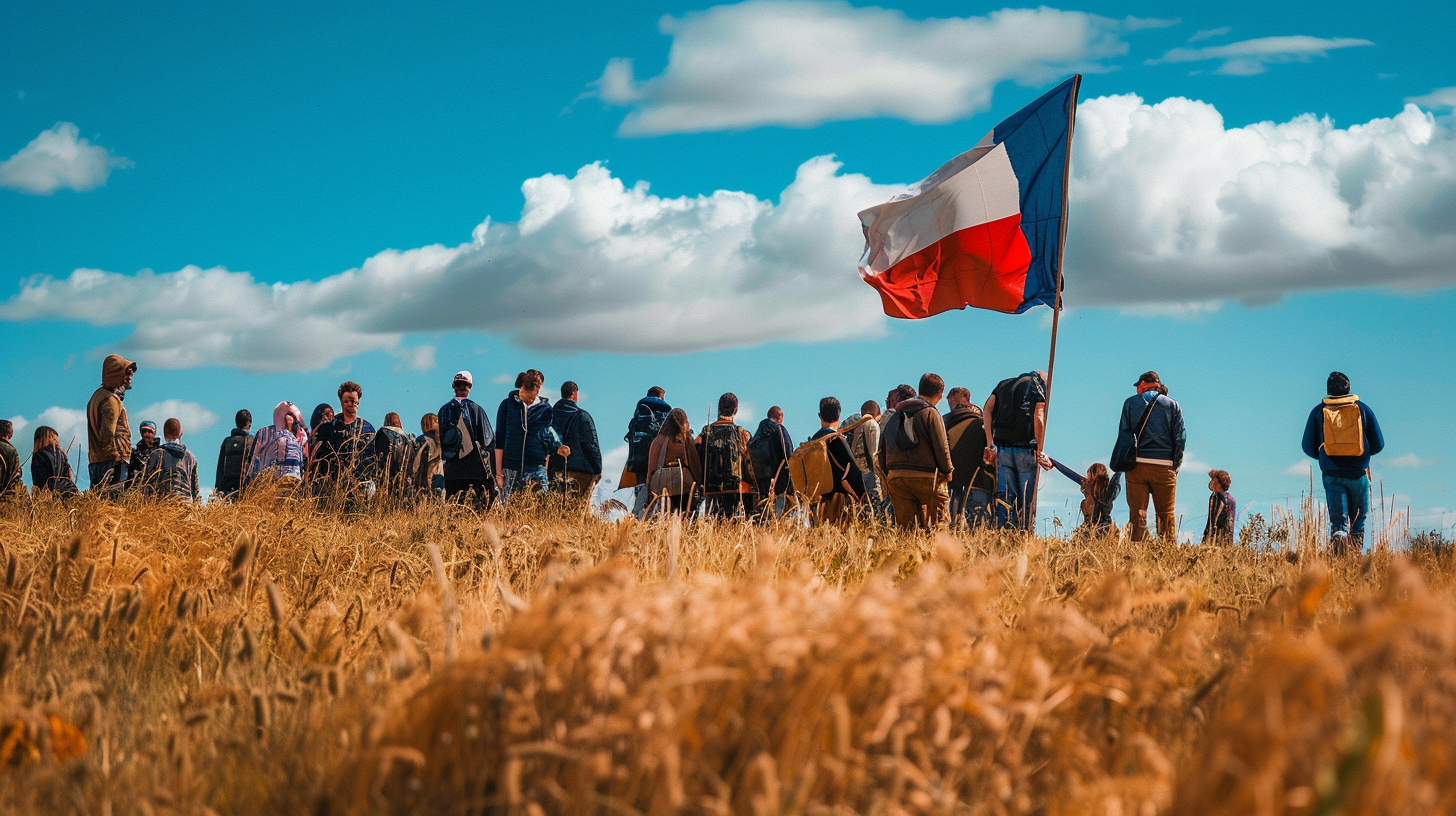
The northwest coast of the country has long been known for its low immigration rates, low crime rates, and low unemployment rates. It has been a peaceful and prosperous region, attracting individuals from all walks of life. However, recent political developments have cast a shadow over this idyllic landscape.
The Rise of the National Rally
In recent years, the far-right National Rally party has gained traction in the northwest coast, despite the region’s relatively low immigrant population, crime rate, and unemployment. This raises questions about the underlying themes and concepts that fuel such support.
The party has successfully presented a narrative that resonates with some residents of the region, tapping into their fears and insecurities. By portraying immigration, crime, and unemployment as imminent threats, the National Rally has successfully ignited a fear-based movement, even in areas where these issues are minimal.
Exploring the Underlying Themes
It is crucial to delve deeper into the underlying themes that contribute to the rise of the National Rally. While the northwest coast may not have experienced significant immigration, crime, or unemployment, it does not negate the concerns and anxieties of its residents.
It is important to recognize the power of perception. The mere suggestion that these issues could impact the region in the future is enough for some individuals to rally behind the National Rally’s agenda. Fear can be a potent motivator, especially when it aligns with preconceived notions or biases.
This phenomenon is not unique to the northwest coast. It speaks to a broader issue of widespread fear and uncertainty, which can be exploited by political parties seeking to gain influence. By equating immigrants, crime, and unemployment as a unified threat, the National Rally has successfully leveraged this uncertainty to further its own agenda.
Proposing Innovative Solutions
To counter the growing influence of fear-based narratives, it is essential to propose innovative solutions that address the underlying concerns of residents. Education and open dialogue are crucial tools in combating misinformation and dispelling fears.
Firstly, fostering a sense of community and understanding can help reduce the anxieties associated with immigration, crime, and unemployment. Bringing individuals together from diverse backgrounds can promote empathy and dispel stereotypes.
Secondly, investing in education and job opportunities can address the genuine concerns surrounding unemployment. By providing individuals with the necessary skills and resources, they can partake in the region’s prosperity and feel secure in their future.
“Fear can be a potent motivator, especially when it aligns with preconceived notions or biases.”
Furthermore, implementing evidence-based policies that address crime prevention can help alleviate concerns about public safety. By focusing on community policing, rehabilitation programs, and social support networks, the region can maintain its reputation as a low-crime area, while promoting unity and understanding.
Conclusion
The rise of the National Rally in the northwest coast, despite the region’s minimal immigration, crime, and unemployment, highlights the power of fear-based narratives and the need for innovative solutions. By addressing the underlying concerns of residents through education, dialogue, and targeted policies, the region can combat the divisive rhetoric and preserve its peaceful and prosperous nature.