
The Enigmatic Nature of Black Hole Singularities
Black holes are one of the most mysterious and intriguing phenomena in the universe. These massive objects, formed from the remnants of collapsed stars, have such strong gravitational pull that not even light can escape their grasp. At the heart of every black hole lies a singularity, a point of infinite density and zero volume where the laws of physics as we know them break down. The enigmatic nature of black hole singularities has puzzled scientists for decades, leading to numerous theories and debates about what lies beyond the event horizon.
One of the most perplexing aspects of black hole singularities is the concept of infinite density. According to our current understanding of physics, matter cannot be compressed to infinite density without violating the laws of quantum mechanics. This has led to the development of theories such as quantum gravity, which seeks to reconcile the principles of general relativity and quantum mechanics in order to explain the behavior of singularities.
Another puzzling aspect of black hole singularities is the idea of zero volume. If a singularity has zero volume, then it must also have zero dimensions, which defies our understanding of space and time. This has led some scientists to speculate that singularities may be portals to other dimensions or alternate universes, where the laws of physics are completely different from our own.
The existence of black hole singularities also raises questions about the nature of time and causality. According to general relativity, time slows down as you approach the event horizon of a black hole, eventually coming to a standstill at the singularity. This has led to the idea that singularities may be points in spacetime where past, present, and future all converge, creating a timeless and chaotic environment where the laws of physics no longer apply.
Despite the many mysteries surrounding black hole singularities, scientists continue to study them in order to gain a better understanding of the nature of the universe. Recent advancements in theoretical physics, such as the development of string theory and loop quantum gravity, have provided new insights into the behavior of singularities and the possibility of a unified theory of physics that can explain their enigmatic nature.
In conclusion, the enigmatic nature of black hole singularities continues to fascinate and perplex scientists around the world. As we continue to explore the mysteries of the universe, the study of black holes and their singularities will undoubtedly play a crucial role in shaping our understanding of the fundamental laws of physics and the nature of reality itself.
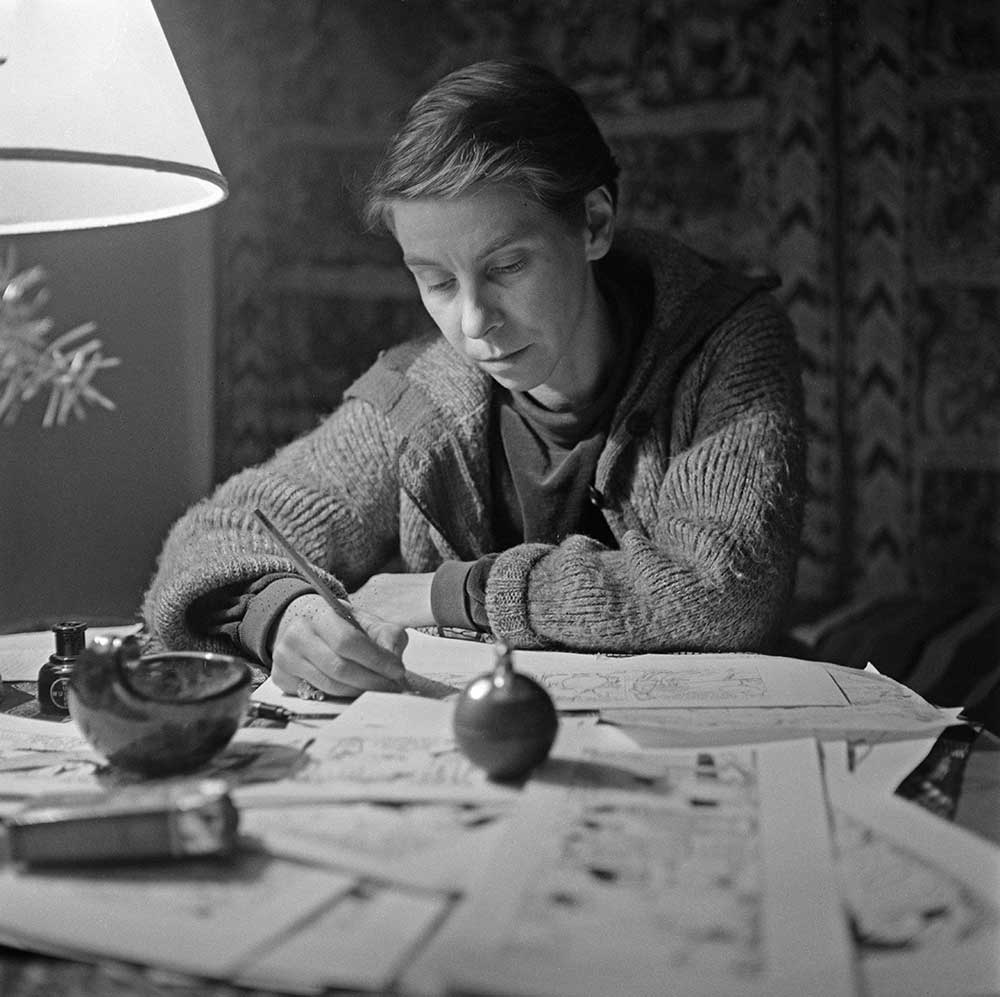
The quietly radical politics of Tove Jansson’s Moomins
In their 80th year, the Moomins (or Moomintroll, in the original Swedish) are enduringly beloved. Alongside other legends of children’s illustration, such as Dick Bruna’s Miffy, and Charles M Schulz’s Snoopy, the Moomins can be found on keyrings, mugs and t-shirts in gift shops all around the world. But this aestheticisation of the Moomin image is a relatively modern development. Tove Jansson’s original series has nine books, in addition to several picture books and comic strips, and in the years since, there have been a number of animated TV and film iterations of the Moomin story, including 2014’s Moomins on The Riviera (dir. Xavier Picard).
The simplicity of the Moomins’ design (they don’t have mouths or noses!), and the apparent quaintness of their stories, might deceive the casual observer into believing there is little depth in Jansson’s work, but a closer look reveals a great complexity in her storytelling, with none more perceptive to this complexity than Jansson’s child reader.
After Pictureville’s screening of Moomins on The Riviera on 23 May, a panel of Moomin experts from The Conversation discussed the cultural significance of Tove Jansson’s stories, and what they referred to as their ‘quietly radical’ politics. In particular, the panel explored what the Moomin stories tell us about displacement and the refugee experience—a discussion made all the more significant by its taking place in Bradford, a city whose past and present is inextricably tied to migration.
The Moomins came into being in 1945, with Moomins and The Great Flood. It was the story of a mother (Moominmama) taking her child on the long and treacherous road to reunite with his father. By the end of World War Two, this was, of course, a familiar experience for many, with people all across Europe rendered refugees, and this was very much a part of Jansson’s own lived experience.
It seems that the Moomins’ story of displacement continues to find a resonance among modern refugee experiences. The young Moomin’s story allows children in 2025 to engage with the refugee experience as much as children in 1945. In this vein, Moomin artwork by Palestinian artist Basel Zaraa is being displayed in Bowling Park in Bradford throughout June, as part of Refugee Week.
At Pictureville’s panel, Professor Melanie Ramdarshan Bold emphasised what separates Moomins and The Great Flood from other children’s stories of displacement. She argued that Jansson’s storytelling decentres trauma and doesn’t expect ‘resilience’ of its child protagonist.
The panel felt that this story acknowledges the role of the mother in crisis, whose job is often to protect and safely transport a child, whilst the father is already in the new place, preparing their home (whatever that might look like). Dr Isabel Joley Black discussed how Moominmama’s incredible resourcefulness across all of the Moomin stories (and her seemingly Tardis-like handbag) is in equal parts a powerful, recognisable and hilarious image of motherhood.
Dr Steve Nash praised Jansson’s aversion to a neatly tied-up plot. This tendency—alongside an illustration style that asks for so much to be interpreted with just the eyes, as discussed by Amelia Huw Morgan—respects the intelligence of child readers, and asks them to meet the story halfway. They can think actively, as they read and laugh, and perhaps learn something along the way.
Though reviewers of Moomins on The Riviera debate how well the film serves the spirit of Jansson’s original stories, there are hints of these quietly radical politics within its farcical plot. We see Moominmama creating gardens wherever she can (including the sea!), in the hopes they can be enjoyed by any- and everyone, and at no monetary cost, which speaks to how she values nature and community.
Moomins on The Riviera presents a running joke in which the Moomins don’t understand that they are expected to produce money in exchange for the lavish things they’re offered. Their inability to understand money is endearing, but also quite representative of their way of life in Moominvalley—where community, kindness and sharing make such things redundant.
At the panel, Amelia Huw Morgan drew attention to the moment Moominmama and Moominpapa are asked, “You are not rich?” to which Moominmama replies “Not in the way you understand it.” She believed this tapped into the heart of what the Moomins are about. They’ve known struggle, and their lives are simple, but they are rich in happiness, rich in family and community, and rich in love.
Look Before You Leap: A GUI-Critic-R1 Model for Pre-Operative Error Diagnosis in GUI Automation
arXiv:2506.04614v1 Announce Type: new Abstract: In recent years, Multimodal Large Language Models (MLLMs) have been extensively utilized for multimodal reasoning tasks, including Graphical User Interface (GUI) automation. Unlike general offline multimodal tasks, GUI automation is executed in online interactive environments, necessitating step-by-step decision-making based on real-time status of the environment. This task has a lower tolerance for decision-making errors at each step, as any mistakes may cumulatively disrupt the process and potentially lead to irreversible outcomes like deletions or payments. To address these issues, we introduce a pre-operative critic mechanism that provides effective feedback prior to the actual execution, by reasoning about the potential outcome and correctness of actions. Specifically, we propose a Suggestion-aware Gradient Relative Policy Optimization (S-GRPO) strategy to construct our pre-operative critic model GUI-Critic-R1, incorporating a novel suggestion reward to enhance the reliability of the model’s feedback. Furthermore, we develop a reasoning-bootstrapping based data collection pipeline to create a GUI-Critic-Train and a GUI-Critic-Test, filling existing gaps in GUI critic data. Static experiments on the GUI-Critic-Test across both mobile and web domains reveal that our GUI-Critic-R1 offers significant advantages in critic accuracy compared to current MLLMs. Dynamic evaluation on GUI automation benchmark further highlights the effectiveness and superiority of our model, as evidenced by improved success rates and operational efficiency.
FGAS: Fixed Decoder Network-Based Audio Steganography with Adversarial Perturbation Generation
arXiv:2505.22266v2 Announce Type: replace-cross Abstract: The rapid development of Artificial Intelligence Generated Content (AIGC) has made high-fidelity generated audio widely available across the Internet, providing diverse cover signals for covert communication. Driven by advances in deep learning, current audio steganography schemes are mainly based on encoding-decoding network architectures. While these methods greatly improve the security of audio steganography, they typically require complex training and large pre-trained models. To address the aforementioned issues, this paper pioneers a Fixed Decoder Network-Based Audio Steganography with Adversarial Perturbation Generation (FGAS). Adversarial perturbations carrying secret message are embedded into the cover audio to generate stego audio. The receiver only needs to share the structure and weights of the fixed decoder network to accurately extract the secret message from the stego audio, this eliminates the reliance on large pre-trained models. In FGAS, we propose an audio Adversarial Perturbation Generation (APG) strategy and design a lightweight fixed decoder. The fixed decoder guarantees reliable extraction of the hidden message, while the adversarial perturbations are optimized to keep the stego audio perceptually and statistically close to the cover audio, thereby improving resistance to steganalysis. The experimental results show that FGAS significantly improves the quality of stego audio, achieving an average PSNR gain of over 10 dB compared to SOTA methods. Moreover, FGAS exhibits superior anti-steganalysis performance under different relative payloads; under high-capacity embedding, it achieves a classification error rate about 2% higher, indicating stronger anti-steganalysis performance compared to current SOTA methods.