Large Language Models (LLMs) have revolutionized the field of automated code generation, especially in complex domains like hardware design. The ability of LLMs to understand natural language and generate code from textual descriptions has been a game-changer. However, the challenge lies in adapting these models to specific tasks like generating Verilog code.
Existing approaches that rely heavily on human intervention and fine-tuning are not scalable in automated design workflows. The introduction of EvoVerilog, which combines LLMs with evolutionary algorithms, marks a significant step towards addressing these limitations. By using a multiobjective, population-based search strategy, EvoVerilog is able to explore a wide range of design possibilities without the need for continuous human input.
What makes EvoVerilog impressive is its ability to not only generate functional Verilog code but also optimize resource utilization. This is crucial in hardware design, where efficient use of resources can impact the performance and cost of the final product.
The impressive performance of EvoVerilog on the VerilogEval benchmarks highlights its potential to outperform existing approaches. By simultaneously generating diverse design solutions, EvoVerilog showcases the power of combining LLMs with evolutionary algorithms in automated code generation.
Overall, EvoVerilog represents a significant advancement in the field of automated hardware design and sets a new standard for performance and scalability in code generation workflows.
The universe is a vast and mysterious place, filled with countless wonders that continue to captivate and intrigue scientists and astronomers alike. Over the centuries, humans have made significant strides in understanding the cosmos, but there is still much that remains unknown. In recent years, advancements in technology and research have allowed us to delve deeper into the mysteries of the universe, leading to new insights and discoveries in the field of cosmology.
One of the most groundbreaking discoveries in cosmology in recent years is the confirmation of the existence of dark matter and dark energy. These two mysterious substances make up the majority of the universe, yet they cannot be directly observed or detected using traditional methods. Dark matter is believed to make up about 27% of the universe, while dark energy accounts for approximately 68%. Scientists are still working to understand the nature of these enigmatic substances and their role in shaping the universe.
Another area of interest in cosmology is the study of cosmic inflation, a theory that suggests the universe underwent a rapid period of expansion in the moments following the Big Bang. This theory helps to explain the uniformity and structure of the universe that we observe today. Recent observations of the cosmic microwave background radiation, the afterglow of the Big Bang, have provided further evidence in support of the inflationary model.
The study of black holes has also been a major focus of cosmological research in recent years. These mysterious objects, formed from the remnants of massive stars, possess such strong gravitational forces that not even light can escape their grasp. Scientists have made significant progress in understanding the behavior of black holes, including their formation, evolution, and interactions with surrounding matter. The recent detection of gravitational waves, ripples in spacetime caused by the collision of black holes, has provided further insights into the nature of these cosmic phenomena.
In addition to these areas of research, cosmologists are also exploring the origins and evolution of galaxies, the distribution of matter in the universe, and the nature of dark energy. Advanced telescopes and observatories, such as the Hubble Space Telescope and the Large Hadron Collider, have allowed scientists to observe the universe in unprecedented detail and gather data that was previously inaccessible.
As our understanding of the universe continues to evolve, new questions and mysteries arise, prompting further research and exploration. The field of cosmology is a dynamic and exciting area of science that offers endless possibilities for discovery and enlightenment. By continuing to push the boundaries of our knowledge and technology, we can hope to unlock the secrets of the cosmos and gain a deeper understanding of our place in the universe.
The Essex director came out swinging with his 2009 debut: a tale of a man who, on the return to his Brighton home after release from prison, decides to find the rat in his criminal organisation. A tale of recrimination, betrayal and murder ensues.
Roots in traditional kitchen-sink drama slowly erode into something grotesque and twisted over a tight 90 minutes, laying the groundwork for Wheatley’s future preoccupations with family, horror and the occasional bad trip.
Kill List (2011)
Part social realism, part folk horror, Kill List follows Neil Maskell’s soldier-turned-hitman Jay as a new job leads him down a sinister path.
Light on plot and heavy on nightmarish imagery, Wheatley produces some of his most arresting work here, taking cues from Get Carter, The Wicker Man, Ken Loach and The Blair Witch Project to create of one the most unique British films of this century.
Sightseers (2012)
Surely one of Wheatley’s most accessible titles, Sightseers is a delightfully twisted romp through the British countryside with couple Chris and Tina (Steve Oram and Alice Lowe).
Sightseers
Their plans for a peaceful break in their caravan quickly turn murderous when they begin offing everyone who annoys them, culminating in a spectacular showdown at the Ribblehead Viaduct.
Nominated for seven BIFA awards and winning for Best Screenplay, we recommend Sightseers as a lighter take on Wheatley’s work.
A Field in England (2013)
Back to folk horror then, and A Field in England, in which a 17th century group descends into a chaos of fighting, arguments and paranoia as they search for treasure.
Shot in stark black and white, the film contains some of the most iconic imagery of Wheatley’s career, with a few choice shots still seared onto our brain (you’ll know when you see it.)
High-Rise (2015)
The work of J.G. Ballard has proved tricky to adapt in the past—think of Cronenberg’s provocative Crash, Spielberg’s sprawling Empire of the Sun and a messy adaptation of Atrocity Exhibition, and you’ll see that spinning Ballard’s speculative sci-fi and sharp satire into a full-blown feature can drive a filmmaker mad—but not Ben Wheatley.
His dystopian take on the author’s prescient novella weaves together glitz, grime and an ABBA needle-drop to produce one of 2015’s best films.
Free Fire (2016)
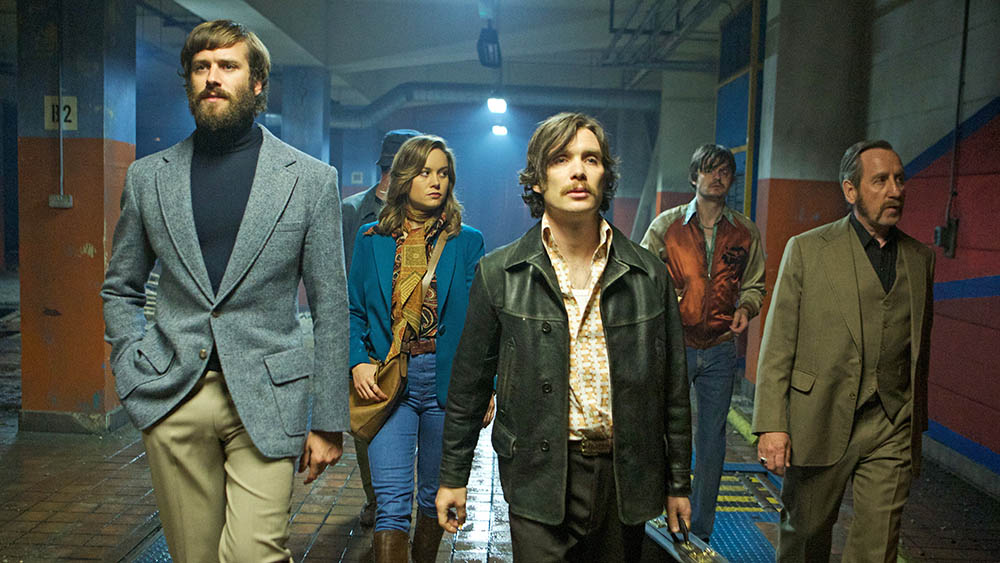
A warehouse, a deal gone wrong and a bloody shootout. Sometimes the best films take a simple hook, cast your favourite stars and let it rip.
Free Fire
Featuring future Oscar winners Cillian Murphy and Brie Larson alongside some of Wheatley’s usual players, the film’s initial look of a Reservoir Dogs spoof descends into something much stranger and farcical (we’d expect nothing less from this director) as mishap after mishap conjures up 90 minutes of mayhem.
Happy New Year, Colin Burstead (2018)
A change of pace for the next one, as the high-octane action Free Fire was followed up in 2018 with this melancholy winter entry. Reteaming with Kill List star Neil Maskell in the lead role, the film tells the story of Colin Burstead, who rents a country house for his eccentric family to celebrate the new year.
With a packed ensemble of incredible character actors including Charles Dance, Hayley Squires and BULK star Sam Riley, the film can in fact be seen as a spiritual successor to Free Fire—we sit back at watch through our fingers as a group descends into chaos.
Rebecca (2020)
There aren’t many directors bold enough to tackle Hitchcock, but, if you hadn’t guessed by now, Ben Wheatley does not do the expected.
This 2020 remake is a lavish Gothic Romance starring Lily James and Armie Hammer, finding a fresh twist on a classic tale of revenge and woe.
In the Earth (2021)
This surreal kaleidoscopic horror taps into pandemic neuroses with razor-sharp precision.
Conceived during the first few weeks of COVID and shot with a small crew over summer 2020, In the Earth finds Wheatley making sense of uncertain times with familiar preoccupations—expect hallucinogens, folk horror and his old friend Reece Shearsmith in a terrific turn.
Meg 2: The Trench (2023)
The natural extension of a director so occupied with deconstructing genre, Meg 2: The Trench finds Wheatley at his most playful, with campy thrills and a great comic role for our chiselled hero Jason Statham.
Vanity Fair dubbed it “Bigger, Sillier and Better” than its predecessor, and we recommend making it a madcap midnight movie night with some pals.
BULK (2025)
While much remains under wraps about Wheatley’s enigmatic next feature, we’ve heard rumours it’s a pulsating, genre-hopping thriller that brings him back to those twisted roots of the early 2010s.
BULK
Ben will be joining us along with actors Sam Riley and Alexandra Maria Lara and producer Andy Starke for a Q&A and screening of BULK on 16 August, fresh from its world premiere at the Edinburgh International Film Festival, and it’s set to be a night to remember.
Discover how MIXI, a leader in digital entertainment and lifestyle services in Japan, uses ChatGPT Enterprise to transform productivity, boost AI adoption across teams, and create a secure environment for innovation.
arXiv:2508.13171v1 Announce Type: new
Abstract: Large Language Models (LLMs) face fundamental limitations in context management despite recent advances extending context windows to millions of tokens. We propose Cognitive Workspace, a novel paradigm that transcends traditional Retrieval-Augmented Generation (RAG) by emulating human cognitive mechanisms of external memory use. Drawing from cognitive science foundations including Baddeley’s working memory model, Clark’s extended mind thesis, and Hutchins’ distributed cognition framework, we demonstrate that current passive retrieval systems fail to capture the dynamic, task-driven nature of human memory management. Our analysis of 2024-2025 developments reveals that while techniques like Infini-attention and StreamingLLM achieve impressive context lengths, they lack the metacognitive awareness and active planning capabilities essential for true cognitive extension. Cognitive Workspace addresses these limitations through three core innovations: (1) active memory management with deliberate information curation, (2) hierarchical cognitive buffers enabling persistent working states, and (3) task-driven context optimization that dynamically adapts to cognitive demands. Empirical validation demonstrates Cognitive Workspace achieves an average 58.6% memory reuse rate (ranging from 54-60% across different tasks) compared to 0% for traditional RAG, with 17-18% net efficiency gain despite 3.3x higher operation counts. Statistical analysis confirms these advantages with p < 0.001 and Cohen's d > 23 across multiple task types, establishing the first quantitative evidence for active memory superiority in LLM systems. We present a comprehensive theoretical framework synthesizing insights from 50+ recent papers, positioning Cognitive Workspace as a fundamental shift from information retrieval to genuine cognitive augmentation.