arXiv:2511.20679v1 Announce Type: new
Abstract: Hyperbolic geometry is an effective geometry for embedding hierarchical data structures. Hyperbolic learning has therefore become increasingly prominent in machine learning applications where data is hierarchically organized or governed by hierarchical semantics, ranging from recommendation systems to computer vision. The quality of hyperbolic embeddings is tightly coupled to the structure of the input hierarchy, which is often derived from knowledge graphs or ontologies. Recent work has uncovered that for an optimal hyperbolic embedding, a high branching factor and single inheritance are key, while embedding algorithms are robust to imbalance and hierarchy size. To assist knowledge engineers in reorganizing hierarchical knowledge, this paper investigates whether Large Language Models (LLMs) have the ability to automatically restructure hierarchies to meet these criteria. We propose a prompt-based approach to transform existing hierarchies using LLMs, guided by known desiderata for hyperbolic embeddings. Experiments on 16 diverse hierarchies show that LLM-restructured hierarchies consistently yield higher-quality hyperbolic embeddings across several standard embedding quality metrics. Moreover, we show how LLM-guided hierarchy restructuring enables explainable reorganizations, providing justifications to knowledge engineers.
Expert Commentary: The Power of Hyperbolic Geometry in Machine Learning
Hyperbolic geometry has emerged as a powerful tool in the field of machine learning, particularly in applications where data is organized hierarchically. This type of geometry allows for efficient embedding of hierarchical structures, making it ideal for tasks such as recommendation systems and computer vision. One of the key insights from recent research is that the quality of hyperbolic embeddings is closely linked to the structure of the input hierarchy, often derived from knowledge graphs or ontologies.
What sets hyperbolic learning apart is its ability to capture complex relationships in hierarchical data with a high branching factor and single inheritance. This means that the algorithms used for embedding are robust to imbalances in the hierarchy size. This understanding is crucial for knowledge engineers looking to optimize their hierarchical knowledge structures for better machine learning performance.
This paper takes a novel approach by exploring the use of Large Language Models (LLMs) to automatically restructure hierarchies in a way that enhances hyperbolic embeddings. By leveraging the capabilities of LLMs, the authors demonstrate how existing hierarchies can be transformed to meet the criteria for optimal hyperbolic embeddings, leading to consistently higher quality results across various metrics.
Moreover, the use of LLMs in hierarchy restructuring offers a level of explainability that is often lacking in machine learning models. By providing justifications for the reorganizations, knowledge engineers can gain valuable insights into the decision-making process behind the restructuring, enhancing transparency and understanding.
This study showcases the multi-disciplinary nature of the concepts at play, bringing together hyperbolic geometry, machine learning, and natural language processing. By combining these diverse fields, researchers are pushing the boundaries of what is possible in hierarchical data analysis and knowledge representation, opening up new possibilities for future advancements in the field.
arXiv:2511.20728v1 Announce Type: new
Abstract: We unify two complementary viewpoints on relativistic spacetime and the counting of fundamental constants. Operationally, Matsas, Pleitez, Saa, and Vanzella (MPSV) have recently argued that relativistic spacetime requires only a single fundamental dimensional constant. Mathematically, theorems due to Alexandrov and Zeeman demonstrate that the light-cone structure determines the spacetime geometry only up to a conformal factor. We show that these approaches are mutually reinforcing: the Alexandrov-Zeeman theorems establish the rigid conformal structure of spacetime, while the “bona fide clock” required by MPSV serves the necessary mathematical role of breaking the dilation symmetry. We provide a formal derivation proving that the normalization of a single clock worldline is sufficient to select a unique metric from the conformal class, thereby clarifying that the number of fundamental constants is exactly one.
Conclusions
The unification of the viewpoints on relativistic spacetime and the counting of fundamental constants by Matsas, Pleitez, Saa, and Vanzella (MPSV) alongside the theorems by Alexandrov and Zeeman have shed new light on the structure of spacetime. By recognizing the rigid conformal structure of spacetime and the importance of a single fundamental dimensional constant, we have gained a deeper understanding of the mathematical underpinnings of relativistic physics.
Future Roadmap
Challenges:
Further experimental validation to confirm the implications of the unified viewpoints.
Development of theoretical frameworks to integrate these ideas into existing theories of gravitation and quantum mechanics.
Educational outreach to help disseminate these complex concepts to a wider audience.
Opportunities:
Exploration of new avenues for research in fundamental physics.
Potential breakthroughs in understanding the nature of spacetime and the fundamental constants of the universe.
Collaboration between physicists and mathematicians to delve deeper into the implications of these unifications.
By embracing the unity of these diverse perspectives, we stand at the cusp of a new era in theoretical physics where the mysteries of spacetime and fundamental constants may be closer to resolution than ever before.
Expert Commentary: Bridging the Gap Between Intrinsic and Extrinsic Evaluations of Large Language Models in Nutrition Chatbots
The use of large language models (LLMs) in the form of chatbots holds great promise for revolutionizing the field of nutrition by providing personalized advice and support to users. However, a key challenge in gaining widespread trust and acceptance of these LLM-based chatbots lies in the lack of rigorous extrinsic evaluations, particularly in comparison to the gold standard of randomized controlled trials (RCTs) commonly used in evidence-based research.
In this groundbreaking study, researchers aimed to address this gap by conducting the first RCT involving LLMs for nutrition chatbots. By augmenting a rule-based chatbot with LLM-based features such as message rephrasing and nutritional counseling, the study sought to evaluate the impact of LLM integration on dietary outcomes, emotional well-being, and user engagement over a seven-week period with a sample size of 81 participants.
While previous intrinsic evaluations of the LLM-based features showed promising results, the real-world deployment in the RCT did not consistently translate into tangible benefits for users. This discrepancy underscores the importance of moving beyond solely intrinsic evaluations and considering the broader, real-world impact of LLM-based systems in practical settings.
These findings emphasize the need for interdisciplinary collaborations and human-centered approaches to further develop and refine LLM-based chatbots in the field of nutrition. By bridging the gap between intrinsic and extrinsic evaluations, researchers can gain a more comprehensive understanding of the effectiveness and limitations of LLM-based systems, ultimately paving the way for evidence-based deployment and widespread acceptance of these innovative technologies.
For more details on the study methodology, results, and code, please visit: this https URL.
The universe is a vast and mysterious place, filled with countless wonders that continue to captivate and intrigue scientists and astronomers alike. Over the years, our understanding of the cosmos has grown exponentially, thanks to advancements in technology and the tireless efforts of researchers around the world. In recent years, cosmologists have made significant breakthroughs in unraveling some of the universe’s most perplexing mysteries, shedding light on the origins and evolution of the cosmos.
One of the most exciting developments in cosmology in recent years is the discovery of dark matter and dark energy. Dark matter is a mysterious substance that makes up about 27% of the universe, yet it does not emit, absorb, or reflect light, making it invisible and undetectable by traditional telescopes. Despite its elusive nature, scientists have been able to infer the existence of dark matter through its gravitational effects on visible matter in the universe. Dark energy, on the other hand, is a mysterious force that is causing the universe to expand at an accelerating rate. Together, dark matter and dark energy make up about 95% of the universe, leaving only 5% for visible matter such as stars, planets, and galaxies.
Another major breakthrough in cosmology is the confirmation of the existence of gravitational waves, ripples in the fabric of spacetime that are produced by cataclysmic events such as the collision of black holes or neutron stars. In 2015, the Laser Interferometer Gravitational-Wave Observatory (LIGO) made history by detecting gravitational waves for the first time, confirming a key prediction of Albert Einstein’s theory of general relativity. Since then, LIGO and other gravitational wave detectors have detected numerous gravitational wave events, providing astronomers with a new tool to study the universe and explore its most extreme phenomena.
Cosmologists have also made significant progress in understanding the early universe and the processes that led to the formation of galaxies and other cosmic structures. The cosmic microwave background radiation, leftover radiation from the Big Bang, has provided valuable insights into the conditions of the early universe and the seeds of cosmic structure. By studying the cosmic microwave background, scientists have been able to refine our understanding of the age, composition, and geometry of the universe, as well as the processes that gave rise to the first galaxies and stars.
As our understanding of the universe continues to deepen, cosmologists are faced with new questions and challenges that push the boundaries of our knowledge. From the nature of dark matter and dark energy to the search for extraterrestrial life, there is still much to learn and discover about the cosmos. With ongoing advancements in technology and the collaborative efforts of scientists around the world, we can look forward to even more exciting insights and discoveries in the field of cosmology in the years to come.
In conclusion, the mysteries of the universe continue to fascinate and inspire us, driving us to explore the cosmos and unlock its secrets. Through the efforts of dedicated researchers and the power of technology, we are making remarkable progress in unraveling the mysteries of the cosmos and gaining a deeper understanding of our place in the universe. As we continue to push the boundaries of our knowledge, the future of cosmology looks brighter than ever, promising new insights and discoveries that will shape our understanding of the universe for generations to come.
Bradford Digital Creatives has supported 1,860 students across six secondary schools, helping young people build new skills, discover hidden talents, and gain confidence in their own creative potential.
Funded by Arts Council England, Bradford 2025 UK City of Culture, and Bradford Council, the programme invited students to collaborate with professional artists on digital projects ranging from 360° filmmaking and soundscapes to Virtual Reality, light art and games design. Their work went on to be showcased in the Reel BFD: Digital Arts, Bradford Stories exhibition, in school displays across the district, and even on the dome of the iconic Jodrell Bank planetarium.
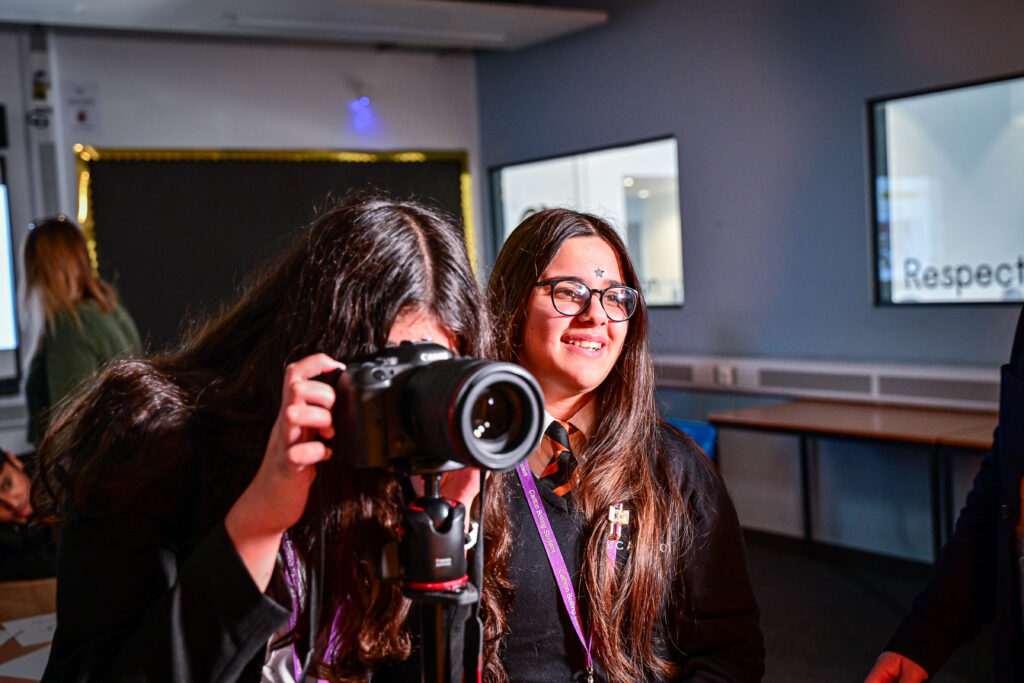
Students taking part in a Bradford Digital Creatives workshop at Carlton Bolling.
The final project report highlights the scale of the programme’s impact:
Over half of participating students reported increased interest in digital arts
7 in 10 gained new creative knowledge and skills
1 in 3 said they are now more likely to seek out digital arts activities
Students were significantly more likely to consider creative careers after taking part
90% of teachers said the project was valuable for their students and increased their own confidence with digital tools
Lindsay Wilson, Deputy Headteacher at Carlton Bolling, described witnessing a “transformation” in her school community, with students collaborating across friendship groups, discovering new abilities, and inspiring conversations at home about creative futures.
Many of the young people involved have already taken their experiences further. A 14-year-old student became a BAFTA Young Game Designers finalist after taking part in a workshop; Carlton Keighley launched a student-led Games Design Club; and several students have chosen new routes in education thanks to the skills and confidence they gained.
Sally Folkard, Head of Screen and Cultural Engagement at the museum, said the programme’s success lay in the exchange between artists and students:
“It wasn’t just about delivering workshops, but about sharing experiences, building confidence, and forging sustainable relationships between education and culture.”
The project is also part of Age of Wonder, Born in Bradford’s internationally significant research programme tracking adolescent health and wellbeing. It marks the first time creativity has been measured on this scale as part of a major longitudinal study.
Professor Rosie McEachan said the findings confirm that creativity can play a powerful role in supporting young people’s confidence, wellbeing and ambition.
With further funding secured, Bradford Digital Creatives will continue until March 2026. The partners are now working to develop a long-term model that embeds digital arts across more schools and strengthens connections between education, culture and industry.
Rhiannon Hannon, Director of Creative Engagement and Participation at Bradford 2025, said the project “opened up new possibilities for hundreds of students across the district,” aligning strongly with Bradford 2025’s mission to empower young people and amplify their voices.
As Lindsay Wilson reflected: “This project has set the bar for what creative education can be – collaborative, inclusive and transformative.”