
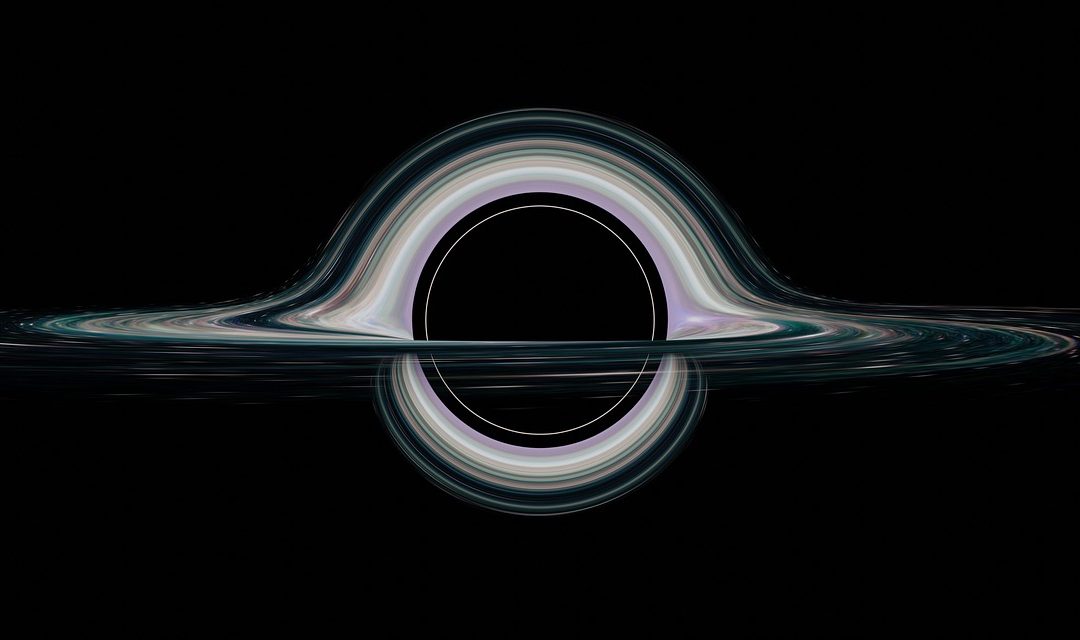
Black holes are some of the most mysterious and fascinating objects in the universe. These regions of space are so dense that nothing, not even light, can escape their gravitational pull. At the heart of a black hole lies a singularity, a point of infinite density where the laws of physics as we know them break down.
The concept of a singularity was first proposed by physicist Albert Einstein in his theory of general relativity. According to this theory, when a massive star collapses under its own gravity, it forms a singularity at its center. This singularity is a point of infinite density and zero volume, where the gravitational pull is so strong that even light cannot escape.
The existence of a singularity within a black hole raises many questions and challenges our understanding of the universe. For one, the laws of physics as we know them, including general relativity, cannot accurately describe what happens at the singularity. At such extreme densities, the equations of general relativity break down, leading to what is known as a “singularity problem.”
One possible solution to this problem is the theory of quantum gravity, which seeks to unify the principles of general relativity with those of quantum mechanics. According to this theory, at the singularity, matter and energy are so densely packed that they behave in ways that are not described by classical physics. Instead, quantum effects come into play, leading to a new understanding of the nature of space and time.
Another intriguing aspect of black hole singularities is the concept of “spaghettification.” As an object falls into a black hole, the intense gravitational pull causes it to be stretched and elongated into a long, thin shape resembling a strand of spaghetti. This phenomenon occurs because the gravitational force at the singularity is so strong that it overcomes the internal forces holding the object together.
Despite the challenges and mysteries surrounding black hole singularities, scientists continue to study them in order to gain a better understanding of the nature of the universe. By observing the effects of black holes on their surrounding environment, such as the bending of light and the emission of radiation, researchers hope to uncover new insights into the fundamental laws of physics.
In conclusion, black hole singularities represent some of the most extreme and enigmatic phenomena in the universe. These points of infinite density challenge our understanding of the laws of physics and push the boundaries of our knowledge of the cosmos. As scientists continue to explore and study black holes, we may one day unlock the secrets of these mysterious objects and gain a deeper understanding of the nature of the universe.