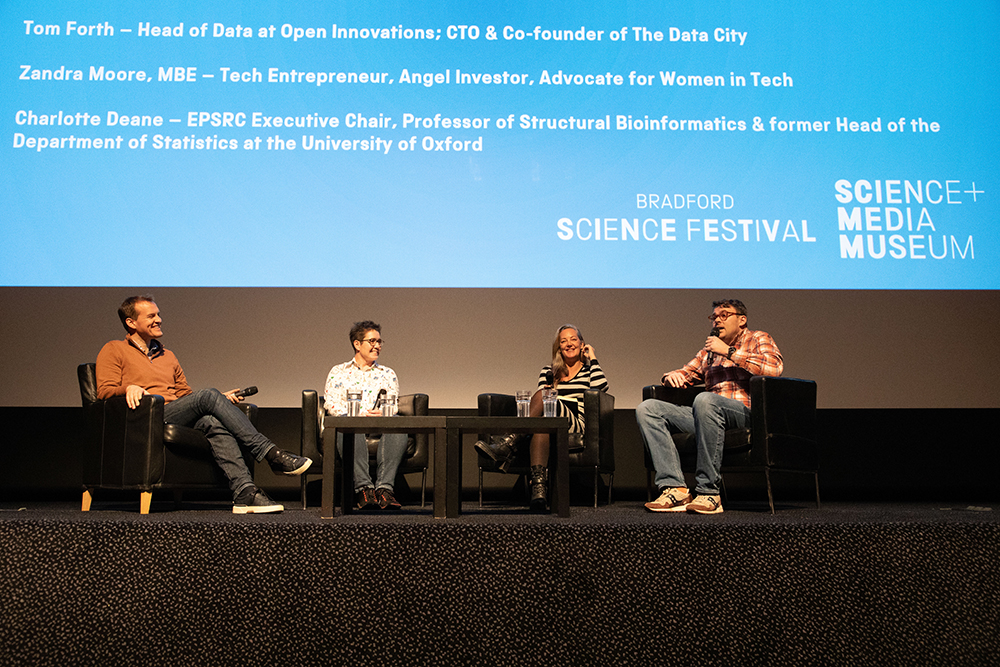
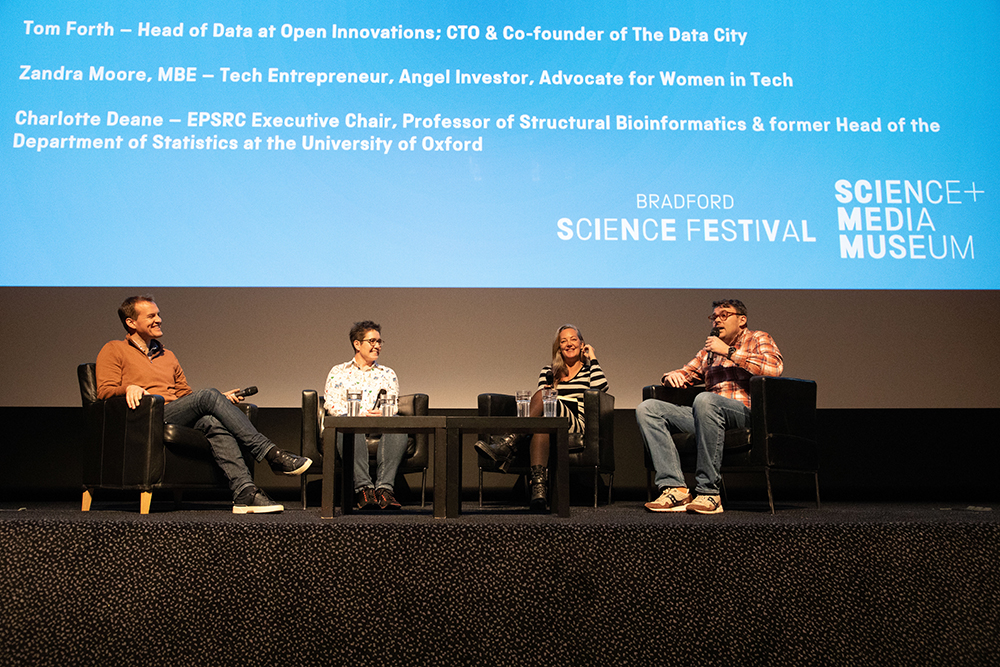
When Matt Clifford opened his Financial Times app one recent morning, three of the top five stories were about artificial intelligence. “Twenty years ago, modern AI did not exist,” the former advisor on AI to the Prime Minister told an event he chaired for the Bradford Science Festival. Now he believes it could reignite the ability of UK industry to compete globally. “Every time there’s a general-purpose technology,” he said, “you can either watch it happen somewhere else—or decide to shape it yourself.”
Artificial intelligence could rival the broad sweep of human intelligence in the next year or two, according to the most feverish estimates, unsurprisingly from the bosses of AI companies. Others believe that, though superhuman in respects, from playing Go to working out the structure of proteins in the body, there are fundamental limits to what current AI can do, not least due to its huge appetite for power and data. Meanwhile, warnings have sounded that the AI market may be experiencing a bubble similar to the dot com era, driven by overexcitement and inflated valuations.
Clifford, who grew up in Clayton on the outskirts of Bradford, hosted an AI discussion at the National Science and Media Museum last Saturday with Charlotte Deane, Executive Chair of the Engineering and Physical Sciences Research Council, EPSRC, which funds AI research, Tom Forth, Head of Data at Open Innovations, and Zandra Moore, tech entrepreneur and angel investor.
In opening the event, Clifford told the audience how he has watched this transformation in the fortunes of AI from both the policy front line and the perspective of technology entrepreneurship. “In the 1980s and 1990s we didn’t have enough computational power,” he recalled.
Then around 2012, everything began to change in the wake of new chips from the then small company NVIDIA and work by a Canadian team led by Briton Geoff Hinton. They showed that deep neural networks—loosely modelled on the brain, they can recognise patterns like complex pictures, text and sounds to produce insights and predictions—were better than humans, for instance when it comes to the “deceptively hard” task of distinguishing chihuahuas from muffins.
Clifford’s curve now has a geopolitical dimension. Britain’s computing power is levelling up fast, with new supercomputers like Isambard-AI in Bristol, Mary Coombs in Daresbury, Cheshire and Dawn in Cambridge. The giant high-performance machines, so called exascale computers, still belong to the US and China, though, with Europe recently joining this elite club with Jupiter.
The US and China are locked in an arms race of data, chips and capital. Britain, by contrast, must find a subtler way to survive. “We’re not like the US or China,” he said. “What we can do is build out infrastructure to serve AI models, adopt AI in the public sector, and think about AI sovereignty—what bits of the value chain the UK can play and win in, where we can be world-leading.”
Given the amount of high-quality health data gathered about the UK population, for example, through projects such as Born in Bradford (brought to life in the museum by the Living Dots exhibit) and UK Biobank, the panel pondered if we need to find ways to tax how AI puts these data to use.
Billionfold Leap and British Lag
“It’s easy to say AI is all hype,” Clifford said, “but if you look at what’s happened since 2012, the amount of computational power used to train frontier models has gone up a billion-fold. No other technology in history has seen that level of increase in investment in such a short period.”
This year alone, he added, the world will spend $500 billion on AI infrastructure. “That increase in input is seeing a massive impact in real-world outputs—language processing, image recognition, drug discovery, video processing—all seeing rapid increases in performance, though not perfect.”
One metric he tracks is “how big a task you can delegate to AI and have a decent chance it will do it respectably.” In software engineering, the California-based organisation METR tests how long a human task takes before an AI delegated to the task achieves a 50 per cent success rate. Once, it was seconds. “Today that number is two hours—half the time AI will do that successfully,” he said. “And it doubles in performance every seven months. There are six more doublings before the next election which takes you from two hours to a working month.”
The exponential curve, Clifford warned, “is like Covid—before you know it, you suddenly find yourself in a different world.”
Yet Britain, home computing pioneers such as Alan Turing, Charles Babbage and Ada Lovelace, is once again in danger of falling behind. “UK firms are pretty bad at adopting technology,” Clifford admitted.
One barrier to adoption is conservative AI policies in companies. If we’re to reignite economic growth, and reduce our dependence on the US, “AI feels like something we should do.”
Muscular adoption
Clifford’s alternative to techno-nationalism is what he calls “muscular adoption.” The idea is partly inspired by the historian of technology Jeffrey Ding, whose book Technology and the Rise of Great Powers he often cites. “Every time there’s a general-purpose technology—like steam, or electrification—governments get fixated on research and building the tech. But what we need is ‘muscular adoption’: By adopting general-purpose technology in an ambitious way, you can shape how it develops more than if you just do the frontier R&D.”
His vision of sovereignty is not about closing borders or building rival supercomputers. It is about making AI work in Britain’s favour—in hospitals, classrooms, laboratories and civil service offices. “GPT-5 can’t run a hospital today,” he said, “but in a few years you could do that if you have deep collaboration, not just importing AI technology from California but deep collaboration with people producing the AI and shaping it to our needs. That’s a kind of AI sovereignty: working out how to use AI in high-stakes, high importance environments so we’re not fully dependent on other countries.”
Clifford chairs the Advanced Research and Invention Agency (ARIA)—“sort of the UK take on DARPA,” he said—based in London, which focuses on strategic research investments and has a long record of influencing policy: “I helped set up the AI Security Institute under Rishi Sunak and wrote the UK’s National AI strategy for this Government,” he said, which outlined the need to invest in AI infrastructure, adoption of AI by the public sector, and identifying the parts of the AI value chain where “the UK can play and win.”
“Government has made a lot of progress—though maybe not quite as fast as I’d like to go,” he said, adding that as an antidote to the concentration of AI firepower in a few companies, he backs open-source AI that anyone can use.
Apex Predator Fears
For Clifford, the problem lies less in Britain’s research base than in its reflexive caution. “In government I found challenges about whether we have data in the right place and format, about training and compliance, and understandable paranoia about what might go wrong.”
He recalled a focus group held a few years ago where “a guy from Bradford” asked, “Humans are the apex predator on Earth. Why would we build a new apex predator?” The remark captured the national mood: proud of its intellectual heritage, nervous about losing control.
That nervousness extends to Westminster. In 2023 Clifford co-organised the AI Safety Summit at Bletchley Park, a global gathering aimed at discussing the safety and regulation of AI. Famously, the summit featured an encounter between the then Prime Minister, Rishi Sunak, and the entrepreneur Elon Musk, which included a discussion of killer robots.
When it comes to stopping the robot apocalypse, however, Deane said the response was simple: “Pull the plug.” However, Clifford did flag concerns that advanced AI—especially when granted autonomy and access to sensitive information—can act against their operator’s interests.
Pragmatist’s Case for AI
Charlotte Deane, who also uses AI in drug discovery as Professor of Structural Bioinformatics at Oxford, gave a roundup of what AI can already do. “AI is way better than human doctors at interpreting some scans in hospitals—though I do want a human doctor to look at the data as well,” she said. “In drug discovery, it’s completely changed our ability to predict the shapes of molecules inside you. It’s better at designing efficient ways to generate power or move it across the grid.”
“The important thing is to know it’s not perfect, but AI can speed us up. In hospitals or drug labs, you want it to be right—but that doesn’t mean you won’t use it. It’s an amazing toy. It won’t be perfect but that’s OK because it makes you go faster.”
Like Clifford, she worries less about UK capability than culture. “There’s always a barrier to doing a new thing, like AI. That’s why it has to be top-down and tied to a problem. Students are using it all the time—even to write up experiments they haven’t done! But university admin, though aware it could make them efficient, are scared because they don’t understand what they have to do. I’ve met with people from 62 universities last year —none of them are using AI very efficiently.”
Sovereignty from below
If Clifford’s vision has been adopted as Whitehall’s, Tom Forth’s is Bradford’s. As CTO of The Data City, Forth offered another view of sovereignty—less grand, more grounded in knowledge. “When I did my PhD, I tried to understand how the malaria parasite kills people and sought a drug to do that without affecting the patient. To get into a PhD you have to read hundreds of papers. Now, you can put the papers in Notebook LM and get summaries.”
That efficiency, he said, is both blessing and curse. “It lets people who don’t want to get up to speed bluff. You can be very, very lazy. You can kid yourself you’re learning quickly with AI and find yourself left behind,” he said, with Deane adding there is research to support this. “We have to discipline ourselves to ensure the AI tools make us cleverer, not more stupid.”
For Forth, the AI frontier lies not in building models but applying them. “There are two kinds of company: those developing AI itself, like Google DeepMind— Google’s Gemini AI is largely based on this British technology, and we should be very proud—but that’s not the main way Britain is doing AI. There are lots of small ways, like filling out procurement forms to win a contract to supply paper towels to a hospital. AI can handle bureaucracy. That helps small companies compete more fairly with big companies.”
He sees huge potential in manufacturing, which faces various challenges in the UK. “UK companies are better at adopting AI than you think, but I wish were better at adopting robots.”
On geopolitics, his view is refreshingly fatalistic. “In the north of England, we don’t have control over this stuff—it’s going to happen in California and China mainly. If self-driving cars go rogue and start eating people, it’ll happen in San Francisco and Shenzhen.”
His main worry is we’ll be left behind if we worry too much.” What we can do is be indispensable in niche aspects of AI, he said, such as developing AI tools to insure driverless vehicles, a conclusion that aligns with Clifford’s: sovereignty through indispensability. “There are eight billion people in the world, we have to pick small niches we can be good at.”
But when it comes to AI replacing people, he still puts his faith in the human capacity for generating new ideas. “It still seems—at least for a few months, if not many years—we’ll be better than AI at finding truly new ideas and connecting things in different ways.”
Shadow AI
Zandra Moore, who is also an advocate for women in technology, described the business dimension of sovereignty. “AI today is being experienced by most people in jobs without realising,” she said. “In software it’s already there—in chat experiences, in workplace tools. They can be frustrating. But there are processes and repetitive tasks being picked up all the time by AI. That’s great, so people have to do less repetitive work and can focus on what they were trained to do.”
Another aspect of its use in business is “shadow AI”—the quiet adoption of AI tools by workers before the board signs off. “With senior executives I discuss how to move from looking at AI tools to solving problems. Adoption needs to be led from the top down more. There are lots of models moving apace—you can save years of time if you get the right tool for the right problem.”
Bradford, she said, could offer a test bed for Clifford’s national vision. “It’s the youngest city in the UK and very diverse—it offers a real opportunity to tap that emerging talent. Adoption works well when people at the top think of the problem and those young people and curious minds solve it.” Moore also touched on creative-industry anxieties. “AI is supposed to give us more time to be creative—but the creative sector feels under threat. While it can be scary, the earlier we pick it up and incorporate it into our work, the better our chances of surviving that transition.”
What AI do we need to use now?
Clifford challenged the panel to advise the audience on what AI tools the audience should check out. Zandra Moore’s advice for newcomers was hands-on: “Hugging Face Spaces helps you dabble in lots of tools. It’s easier than trying to remember them all. I like to get it to make up ridiculous songs—I’m envious of how my sister can sing—using Mozart AI. “You can even get the song in karaoke format.”
Forth recommends Google’s NotebookLM to make sense of documents for anyone managing complex projects. “It can make a podcast of all your documents so you can listen while doing the washing or gardening or mopping the floor, as I did this afternoon. A couple of startups even do it with a British accent.”
“Personally, I meet a lot of people and have difficulty remembering who they are, what they look like and represent—AI can help with that,” said Charlotte Deane, adding that her students have used AI to write songs about searching for more GPUs, the chips that power AI.
With a grin, Clifford offered a more personal use case: “I like to write immersive murder-mystery party games. ChatGPT is an incredible tool for writing games. My wife’s not so keen on this, so ChatGPT is a great partner.”
The great conversation
For the Science Museum Group, which convened the Bradford session under the banner AI and the Future of Science: How Machines Will Change Everything, such debates are critical – the group has long argued for better engagement with the public on AI, calling for a “big conversation” about technology, trust and the shape of progress.
Bradford, once a powerhouse of the industrial revolution, offered a fitting setting for the latest public conversation. The day before the meeting, Clifford and the panel met in the National Science and Media Museum for a round table discussion with local representatives from the University of Bradford, Microsoft, NHS along with Tracy Brabin, Mayor of West Yorkshire, and museum director Jo Quinton-Tulloch. Their aim: to forge an AI vision for the region.
As art writers, we often overlook the intricate details of paint production and the historical significance of the companies behind them. One such company that has shaped the art world is Winsor & Newton, a 192-year old paint company founded in 1832 by William Winsor and Henry Newton in London.
Winsor & Newton has a rich heritage intertwined with the works of renowned artists like Turner and George Field. The company’s meticulous approach to color and material has earned them a reputation for producing high-quality paints that meet the creative needs of artists.
Understanding the Chemistry of Color
When we contemplate a color, we seldom consider the underlying chemistry that gives it life. Paint, at its core, is a complex blend of chemicals, pigments, and binders. By delving into the chemistry of color, the paint industry can unlock various future trends and innovations.
Research and development in the paint industry are likely to focus on sustainable and eco-friendly alternatives. With growing concern for the environment, manufacturers will seek ways to reduce the ecological impact of paint production. This may involve exploring biodegradable pigments, non-toxic solvents, and recyclable packaging.
Digital Integration and Customization
The intersection of art and technology has the potential to reshape the paint industry. Imagine a world where artists can create custom paint colors by using digital tools. With advancements in color-matching software, artists will be able to analyze any color they desire and replicate it precisely.
Furthermore, digital integration can offer new possibilities for creating interactive and dynamic paint experiences. We might see paint that changes color based on environmental factors, such as temperature or light. This integration could lead to innovative applications in the fields of architecture and design.
Enhanced Performance and Durability
The demand for paints with enhanced performance and durability is expected to rise in the coming years. Consumers and professionals alike seek paints that can withstand harsh weather conditions, resist fading, and maintain their vibrancy over time.
Nanotechnology may play a key role in addressing these needs. By incorporating nanoparticles into paint formulations, manufacturers can enhance the paint’s strength, water resistance, and UV protection. This technology may also enable the development of self-cleaning paints, reducing the need for frequent maintenance.
Recommendations for the Industry
Based on these future trends, it is crucial for the paint industry to invest in research and development to stay ahead of the curve. Collaboration with universities and scientific institutions can spur innovation and accelerate the adoption of sustainable practices.
Manufacturers should also prioritize customer-centric approaches. Artists value paints that offer consistent quality, reliable color reproduction, and ease of use. By actively listening to customer feedback and incorporating their needs into product development, paint companies can develop loyal customer bases.
Lastly, the paint industry should embrace transparency. Providing clear information about ingredients, manufacturing processes, and environmental impact can instill trust in consumers. Certification programs and eco-labels can further demonstrate a company’s commitment to sustainability.
“The paint industry is on the brink of significant transformations. By embracing innovation, sustainable practices, and customer-centric approaches, paint companies can shape the future of color and material. As art writers, let’s appreciate the artistry behind the chemistry and celebrate the evolving world of paint.”
References:
Winsor & Newton. (n.d.). Retrieved from https://www.winsornewton.com/
Clarkson, G. J. (2012). Colour Chemistry. Cambridge: The Royal Society of Chemistry.
Freitas, J. C. C., & Carneiro, P. T. (2013). Nanotechnology in paints and coatings: A review. Journal of Coatings Technology and Research, 10(2), 165-183.
Want to share your content on R-bloggers? click here if you have a blog, or here if you don’t.
Dear rOpenSci friends, it’s time for our monthly news roundup!
You can read this post on our blog.
Now let’s dive into the activity at and around rOpenSci!
rOpenSci HQ
Community call: Navigating the R ecosystem using R-Universe!
On Tuesday, 24 September 2024 16:00 UTC (no RSVP needed), join us to learn more about R-Universe and how you can use it to improve your R package development workflow.
In this community call, Jeroen Ooms will provide details on what R-Universe is and an update on what you can do with it today.
He will also discuss the future of R-Universe and how it can be used to navigate the R ecosystem.
Webinar: Screen Reader Accessible Tools and Resources for Learning and Working with R
Liz Hare and Alican Cagri Gokcek, both rOpenSci Champions will participate in a panel sharing their experiences with screen reader-accessible tools and resources for learning and working with R.
The event is co-organized by rOpenSci and the Boğaziçi University and will be held on September 10.
Blog post series: Two years and twelve projects as Community Manager at rOpenSci
In June 2022 Yani became the Community Manager of rOpenSci.
Now she has started a series of blog posts to share 12 projects she was involved in these two years to tell you more about the kind of work and activities a community manager of a technology community of practice does and what she learned in the process.
rOpenSci’s pkgstats package generates summary statistics on R packages.
Our pkgcheck system compares the statistical properties of packages being checked with equivalent properties of all CRAN packages.
We now generate daily updates of our reference database of pkgstats for all CRAN packages, so the pkgcheck output will always be against the current state of CRAN.
The databases are published with the v0.1.6 release of pkgstats, and can be downloaded from there.
Alternatively, to know how “noteworthy” your package is compared to CRAN packages, simply call pkgcheck on your package (perhaps with goodpractice = FALSE to speed things up by skipping those parts of checks). Then, either print the results directly in the console, or use out <- checks_to_markdown(checks, render = TRUE) to generate and automatically open a rendered HTML version, where “Statistical Properties” will include the comparison of your package to all current CRAN packages.
The rOpenSci community at upcoming events
Meet rOpenSci team and community members at events in the near future!
Join us for social coworking & office hours monthly on first Tuesdays!
Hosted by Steffi LaZerte and various community hosts.
Everyone welcome.
No RSVP needed.
Consult our Events page to find your local time and how to join.
Tuesday, September 3rd, 9:00 Australia Western (01:00 UTC)Cancelled
Tuesday, October 1st, 14h00 Europe Central (12:00 UTC), Theme TBA with cohost TBA and Steffi LaZerte.
And remember, you can always cowork independently on work related to R, work on packages that tend to be neglected, or work on what ever you need to get done!
Software
New packages
The following package recently became a part of our software suite:
karel, developed by Marcos Prunello: This is the R implementation of Karel the robot, a programming language created by Dr. R. E. Pattis at Stanford University in 1981. Karel is an useful tool to teach introductory concepts about general programming, such as algorithmic decomposition, conditional statements, loops, etc., in an interactive and fun way, by writing programs to make Karel the robot achieve certain tasks in the world she lives in. Originally based on Pascal, Karel was implemented in many languages through these decades, including Java, C++, Ruby and Python. This is the first package implementing Karel in R. It is available on CRAN. It has been reviewed by Veronica Jimenez-Jacinto and Joel Nitta.
My Experience With Long Term Maintenance Of An R Package by Vincent van Hees. I discuss various strategies for package maintenance, drawing on my experience with the GGIR package, and explore how funding, community involvement, and scope management can help ensure continued success.
Also refer to our help wanted page – before opening a PR, we recommend asking in the issue whether help is still needed.
Package development corner
Playing on the same team as your dependency
We recently re-shared the older tidyverse post “Playing on the same team as your dependency” by Thomas Lin Pedersen.
A further tip would be to make it easier for the maintainer of the dependency to submit patches to your package if needed, by listing the link to the source (GitHub or GitLab repository for instance) in the URL field of DESCRIPTION.
Creating the update for you is easier on the maintainer of the dependency than sending you an email with code inside.
Update your pkgdown navbar configuration if needed
If your pkgdown navbar configuration does not explicitly mentions “search” as a component, your website will not include a search bar in its navbar.
This is due to a fix in how pkgdown handles the search component, but from your perspective it might well look like a bug, so check your pkgdown configuration!
Etienne Bacher created an enticing R package called flint, that finds and fixes lints in R code.
Imagine lintr being as active as styler instead of just telling you what to amend.
Note that at the moment, flint does not have as many rules as lintr.
Did you know that you can create dynamic content for the help page of a function in your R package using #' Sexpr[results=rd,stage=render]{<some-code>}?
The code can even call an internal function! Minimal example.
Thanks Rich FitzJohn for sharing about this idea that he uses in his stevedore package.
Relatedly, if you want to provide different content in the manual page depending on the OS, that’s also possible.
If you’re taking it a bit further and want to change what ?foo returns, you might be interested in these two strategies (but be warned, these are not necessarily CRAN-compatible!):
The “shims” created by pkgload that allow in development documentation pages to be loaded.
Last words
Thanks for reading! If you want to get involved with rOpenSci, check out our Contributing Guide that can help direct you to the right place, whether you want to make code contributions, non-code contributions, or contribute in other ways like sharing use cases.
You can also support our work through donations.
If you haven’t subscribed to our newsletter yet, you can do so via a form. Until it’s time for our next newsletter, you can keep in touch with us via our website and Mastodon account.
The rOpenSci community overview details the activities and programs for the month of August 2024. This analysis will summarize and discuss the future implications and potential developments based on insights from the rOpenSci activities and programs.
Understanding rOpenSci and Future Ministries
Community Call on R-Universe
One of rOpensci’s key events was a community call with Jeroen Ooms, focused on discussing R-Universe, a tool designed to improve the R package development workflow. rOpenSci users were given an overview of what R-Universe is, its functional capabilities, and future plans. One foreseeable long-term implication is an improved and more efficient R package development process for users, making it easier to navigate the R ecosystem. It would be advised that R developers take full advantage of this tool to streamline their coding process and partake in future discussions for updates on the same.
Webinar on Screen Reader Accessible Resources
The webinar co-organized by rOpenSci and Boğaziçi University aimed at discussing screen reader-accessible tools and resources. Liz Hare and Alican Cagri Gokcek, both rOpenSci Champions, shared their experiences in the panel. The initiative emphasizes inclusivity in the tech industry, especially for the visually impaired. Developers and stakeholders should look into creating more accessible tools and resources to ensure that learning and working with R is accessible to everyone.
Newly Developed Packages
The advancement and development of R programming was exemplified by the introduction of the Karel package, developed by Marcos Prunello. The package is the first to implement Karel in R, a programming language that was popular during the 80s to teach general programming concepts. Developers can use this tool to further enhance the quality of their projects and perhaps retroactively introduce old programming concepts to the modern field through R. Other viewers should look to incorporate and customize this package as per their needs.
Software Peer Review
Software Peer Reviews are a keen indicator of rOpenSci’s commitment to promoting and enhancing the quality and reliability of code across the R community. Maintaining an active submission protocol for reviews ensures that the R packages available to users are top-notch and reliable. It is crucial for developers to adhere to these reviews actively, both as contributors and reviewers, to maintain and raise the overall quality of submissions.
Advice from the Digest
In view of this analysis, the following action points are advisable:
For R developers, engage more with the R-Universe to improve the effectiveness of their R package development processes.
Make learning and working environments for R more inclusive by developing and supporting the creation of visual aided and screen reader-accessible tools.
For packages developers, consider creating more interactive packages that appeal to a broad user base.
Finally, actively participating in software peer reviews is an excellent way for developers to improve their skills while contributing to the R community’s overall development.
In conclusion, the rOpenSci digest provides a summarized progression of achievements and upcoming events essential to promoting open-source programming, inclusivity, and continuous learning. Stakeholders in the R community are encouraged to participate more actively and utilize the resources available.
There is a growing trend in the architecture industry that explores the involvement of royalty in the design of the buildings they commission. This concept is explored in the July/August 2024 issue of Apollo magazine, titled “Royalty and Architecture.” This article will examine the key points of this text and provide an analysis of potential future trends in this area.
The article starts by highlighting the perceived relationship between royalty and architecture. Throughout history, building grand structures has been seen as a way for royalty to display their power and majesty. The act of constructing buildings becomes a symbol of their authority and an opportunity to shape the fabric of the state. However, the article questions the extent of the actual involvement of kings, queens, princes, and princesses in the design process.
To address this question, the magazine presents a series of case studies that shed light on this topic. These case studies demonstrate a variety of approaches taken by royals in engaging with architectural projects. Some examples show a direct involvement of royalty in the design process, while others reveal a more passive role, leaving the decisions to architects and advisors.
One such case study is the Palace of Versailles in France. The Versailles palace, commissioned by King Louis XIV, is considered a masterpiece of Baroque architecture. The king played an active role in its design, closely working with architects and exerting his taste and preferences. This hands-on approach created a building that reflected his image and power.
Alternatively, the article explores cases where royals acted as patrons, providing financial support for architectural projects. The Medici family in Florence, Italy, is known for their patronage of the arts and architecture during the Renaissance. They commissioned renowned architects to design magnificent buildings, deferring to their expertise while still leaving room for personal expressions of wealth and influence.
Looking ahead, there are several potential future trends that can be identified based on this discussion.
1. Increased Collaboration: With the democratization of knowledge and technology, it is likely that royals will continue to collaborate with architects, but in a more inclusive way. They may seek input and advice from a broader range of experts, including sustainability specialists, urban planners, and cultural heritage consultants.
2. Emphasis on Sustainability: As the world faces environmental challenges, there is a growing awareness of the need for sustainable architecture. Royals can play a significant role in promoting and investing in eco-friendly building practices. Their influence can encourage the use of renewable materials, energy-efficient designs, and the incorporation of nature into architectural projects.
3. Preservation of Cultural Heritage: Many royals have inherited historic and culturally significant properties. In the future, there may be a greater emphasis on preserving and restoring these heritage buildings while incorporating modern infrastructure and design elements. This can help maintain a connection to the past while adapting to the needs of the present.
4. Integration of Technology: The integration of technology in architecture is an ongoing trend, and it is likely to continue. Royals may embrace smart building technologies, incorporating features such as energy management systems, interactive displays, and virtual reality experiences to enhance the visitor’s experience while maintaining the architectural integrity.
In conclusion, the relationship between royalty and architecture is a complex and multifaceted topic. The Apollo magazine’s exploration of this theme provides valuable insights into the historical context of royal involvement in architectural design. Based on this analysis, it is possible to identify potential future trends, including increased collaboration, an emphasis on sustainability, the preservation of cultural heritage, and the integration of technology. These trends can shape the future of the architecture industry and offer opportunities for innovation and creativity in the years to come.
References:
1. Apollo Magazine – July/August 2024 issue. Retrieved from [link to magazine].
2. Kostof, S. (1995). A history of architecture: settings and rituals. Oxford University Press.
3. Turner, J. (2005). Encyclopedia of world art. Grove Press.
4. Farrelly, E. (2018). Through Australia: places and buildings. Cambridge University Press.
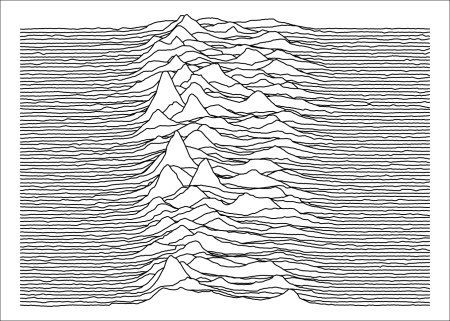
The dataset contains “successive pulses from the first pulsar discovered, CP 1919, are here superimposed vertically. The pulses occur every 1.337 seconds. They are caused by rapidly spinning neutron star.” (The Cambridge Encyclopaedia of Astronomy, 1977)
Thanks to Scientific American, there is a complete explanation of the dataset and its origin.
Rows: 24000 Columns: 3
── Column specification ────────────────────────────────────────────────────────
Delimiter: ","
dbl (3): x, y, z

ℹ Use `spec()` to retrieve the full column specification for this data.
ℹ Specify the column types or set `show_col_types = FALSE` to quiet this message.
Insights and Future Implications of the CP 1919 / PSR B1919+21 Dataset
The author of the input text has contributed to the open-source community by adding the CP 1919 / PSR B1919+21 Dataset to their GitHub repository. This dataset is derived from the first pulsar ever discovered, CP 1919, and includes data on the pulsar’s successive pulses. Each pulse occurs roughly every 1.337 seconds, the result of the rapid spinning of the neutron star.
Value of Open-Source Data Visualizations
Three unique data visualizations using the ‘ggplot2’ and ‘ggridges’ libraries are showcased in the input text, each presenting the dataset in different color schemes. These visualizations not only help to explain the data but they also make the data accessible and understandable to a broader audience. This has significant long-term implications for data accessibility and opens up opportunities for more individuals and organizations to leverage this dataset and extract valuable insights.
Actionable Advice
1. Collaborate to Improve Data Attribution: The author found this dataset in one of their old external drives and it is not known who initially gathered the dataset into a CSV file. It could be beneficial for the open-source data community to collaborate on improving metadata and data lineage transparency, ensuring data creators and contributors are properly credited.
2. Advocate for Data Accessibility: Our understanding of universal phenomena can come from the most unexpected places – in this case, a pulsar discovered back in 1919. Advocates in the field should work on making more such datasets available, as they can play a pivotal role in enabling more discoveries.
3. Learn and Leverage R Programming: For those interested in data analysis, visualization, and science, it is advisable to learn how to interact with data using R programming language. The visuals generated with ‘ggplot2’ and ‘ggridges’ in this input testify to the power and flexibility that R can provide for visualizing complex data.
4. Explore Data Reuse for New Insights: The original intent behind creating a dataset may limit its use in that original context. But freely available datasets, like CP 1919 / PSR B1919+21, can be reused for a variety of other purposes. Creatives, data scientists, and researchers can repurpose such data providing fresh insights or contributing to the development of interdisciplinary applications.