by jsendak | Jan 14, 2026 | Cosmology & Computing
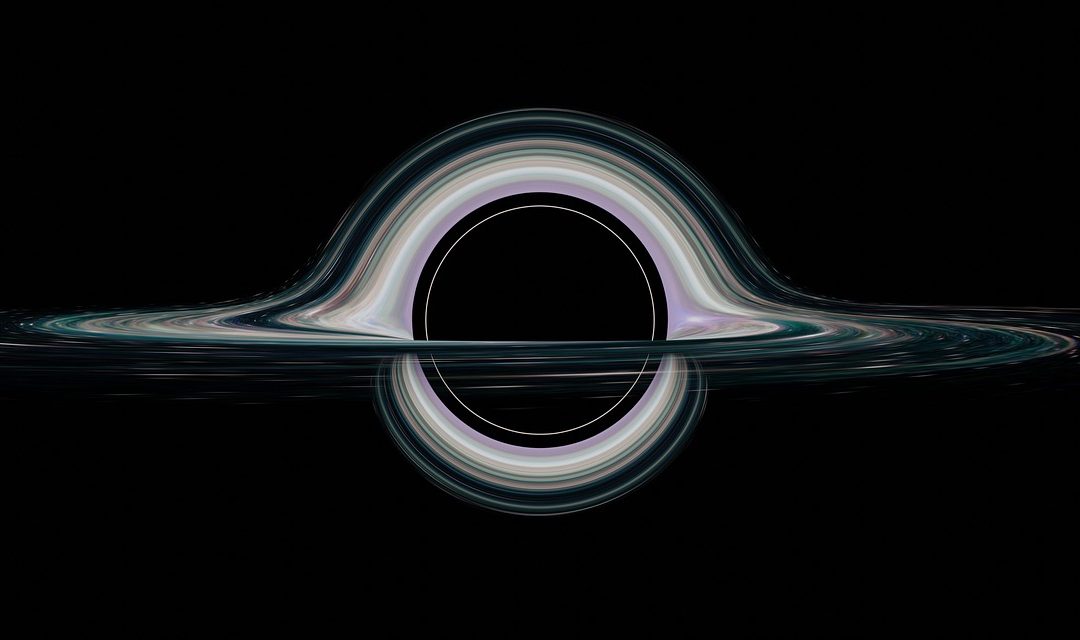
Black holes are some of the most mysterious and fascinating objects in the universe. These regions of space are so dense that nothing, not even light, can escape their gravitational pull. At the heart of a black hole lies a singularity, a point of infinite density where the laws of physics as we know them break down.
The concept of a singularity was first proposed by physicist Albert Einstein in his theory of general relativity. According to this theory, when a massive star collapses under its own gravity, it forms a singularity at its center. This singularity is a point of infinite density and zero volume, where the gravitational pull is so strong that even light cannot escape.
The existence of a singularity within a black hole raises many questions and challenges our understanding of the universe. For one, the laws of physics as we know them, including general relativity, cannot accurately describe what happens at the singularity. At such extreme densities, the equations of general relativity break down, leading to what is known as a “singularity problem.”
One possible solution to this problem is the theory of quantum gravity, which seeks to unify the principles of general relativity with those of quantum mechanics. According to this theory, at the singularity, matter and energy are so densely packed that they behave in ways that are not described by classical physics. Instead, quantum effects come into play, leading to a new understanding of the nature of space and time.
Another intriguing aspect of black hole singularities is the concept of “spaghettification.” As an object falls into a black hole, the intense gravitational pull causes it to be stretched and elongated into a long, thin shape resembling a strand of spaghetti. This phenomenon occurs because the gravitational force at the singularity is so strong that it overcomes the internal forces holding the object together.
Despite the challenges and mysteries surrounding black hole singularities, scientists continue to study them in order to gain a better understanding of the nature of the universe. By observing the effects of black holes on their surrounding environment, such as the bending of light and the emission of radiation, researchers hope to uncover new insights into the fundamental laws of physics.
In conclusion, black hole singularities represent some of the most extreme and enigmatic phenomena in the universe. These points of infinite density challenge our understanding of the laws of physics and push the boundaries of our knowledge of the cosmos. As scientists continue to explore and study black holes, we may one day unlock the secrets of these mysterious objects and gain a deeper understanding of the nature of the universe.
by jsendak | Jan 11, 2026 | Cosmology & Computing
Black holes are one of the most fascinating and mysterious phenomena in the universe. These massive objects, formed from the remnants of dead stars, have such strong gravitational pull that not even light can escape their grasp. At the center of every black hole lies a singularity, a point of infinite density where the laws of physics as we know them break down. Understanding these singularities is crucial to unlocking the secrets of black holes and the nature of the universe itself.
A black hole singularity is a point in space where the gravitational pull becomes infinite and the density becomes infinitely high. This means that the laws of physics as we know them, such as Einstein’s theory of general relativity, no longer apply. At the singularity, space and time are warped to such an extreme degree that they cease to exist as we understand them. This is why black holes are often described as “singularities” – they represent a point where our current understanding of the universe breaks down.
The existence of singularities in black holes raises many questions about the nature of the universe. For example, what happens to matter and energy that falls into a black hole? Does it get crushed into the singularity, or does it somehow escape? And what lies beyond the singularity itself? Is there another universe on the other side, or does the singularity represent the end of space and time as we know it?
One of the most intriguing aspects of black hole singularities is the concept of “spaghettification.” As an object falls into a black hole, the gravitational pull on its leading edge is much stronger than on its trailing edge. This causes the object to be stretched out into a long, thin shape resembling a strand of spaghetti. Eventually, the object will be torn apart by the intense gravitational forces and crushed into the singularity.
Despite the mysteries surrounding black hole singularities, scientists have made significant progress in understanding these enigmatic objects. The discovery of gravitational waves in 2015 provided new insights into the behavior of black holes and their singularities. By studying the ripples in spacetime caused by the merger of two black holes, scientists were able to confirm the existence of black hole singularities and gain a better understanding of their properties.
In the future, researchers hope to delve even deeper into the mysteries of black hole singularities. By combining the principles of general relativity with quantum mechanics, scientists aim to develop a unified theory of gravity that can explain the behavior of singularities and other cosmic phenomena. This could lead to groundbreaking discoveries in the field of astrophysics and revolutionize our understanding of the universe.
In conclusion, black hole singularities are the mysterious heart of a cosmic phenomenon that continues to captivate and intrigue scientists around the world. By studying these enigmatic objects, we can gain valuable insights into the nature of space and time, and perhaps even unlock the secrets of the universe itself. As our understanding of black holes and their singularities continues to evolve, we are sure to uncover new and exciting discoveries that will reshape our view of the cosmos.
by jsendak | Jan 10, 2026 | Cosmology & Computing
Black holes are some of the most mysterious and intriguing objects in the universe. These massive celestial bodies have such strong gravitational pulls that not even light can escape their grasp, making them invisible to the naked eye. However, it is not just their invisibility that makes black holes so enigmatic – it is also their singularities.
A singularity is a point in space where the gravitational pull becomes infinite and the laws of physics as we know them break down. In the case of black holes, the singularity is located at the center, or “heart,” of the black hole. This singularity is thought to be infinitely dense and infinitely small, creating a point of infinite curvature in spacetime.
The enigmatic nature of black hole singularities lies in the fact that our current understanding of physics – specifically, general relativity – cannot fully explain what happens at the singularity. According to general relativity, the singularity is a point of infinite density and infinite gravity, where all matter and energy are crushed into a single point. This leads to a breakdown in the laws of physics as we know them, as they cannot accurately describe what happens at such extreme conditions.
One of the biggest mysteries surrounding black hole singularities is what happens to the information that falls into the black hole. According to the laws of quantum mechanics, information cannot be destroyed – it can only be transformed or hidden. However, when matter falls into a black hole and reaches the singularity, it is thought to be lost forever, leading to what is known as the “information paradox.”
Another mystery surrounding black hole singularities is the concept of time dilation. According to general relativity, time slows down as you approach the event horizon of a black hole, and comes to a complete stop at the singularity. This means that time itself ceases to exist at the singularity, creating a point where past, present, and future all converge.
Despite the enigmatic nature of black hole singularities, scientists are constantly working to better understand these mysterious objects. One theory that has gained traction in recent years is the idea of a “firewall” at the event horizon of a black hole, which would destroy any information that falls into the black hole before it reaches the singularity.
Overall, the enigmatic nature of black hole singularities continues to puzzle and intrigue scientists and astronomers alike. As our understanding of physics and the universe continues to evolve, we may one day unlock the secrets of these mysterious objects and gain a better understanding of the nature of spacetime and the universe as a whole.
by jsendak | Jan 9, 2026 | GR & QC Articles
arXiv:2601.04290v1 Announce Type: new
Abstract: We present a minimal relativistic completion of MOND in which (i) General Relativity is recovered exactly in the high-acceleration regime, while (ii) the Bekenstein–Milgrom (AQUAL) equation emerges in the low-acceleration regime, without introducing additional propagating fields beyond those already present in a right-handed gauge sector. The construction is motivated by an $E_6times E_6$ framework in which $SU(3)_Rrightarrow SU(2)_Rtimes U(1)_{Y’}rightarrow U(1)_{rm dem}$, leaving a healthy repulsive $U(1)_{rm dem}$ interaction whose charge is the square-root mass label. Gravity itself arises from the $SU(2)_R$ connection via a Plebanski/MacDowell–Mansouri mechanism, yielding an emergent tetrad and the Einstein–Hilbert action. MOND is implemented by an infrared (IR) metric deformation $Delta S_{rm IR}[g]$ that is UV-vanishing (so GR is recovered) while its deep-MOND/static limit is fixed by a symmetry principle: in three spatial dimensions, the deep-MOND action is conformally invariant with a 10-parameter group isomorphic to $SO(4,1)$ (the de Sitter group). The single MOND acceleration scale is set by a de Sitter radius selected dynamically in the IR, $a_0=c^2/(xi,ell_{rm dS})$ with $xi={ O}(1)$ fixed by matching to the static limit. MOND resides in perturbations and quasistatic systems; the homogeneous FRW background is controlled by the IR vacuum kinematics rather than an ad hoc cosmological constant.
Conclusions
The article presents a novel approach to combining General Relativity and MOND theory in a relativistic framework, utilizing a right-handed gauge sector within an $E_6times E_6$ framework. By recovering General Relativity in high-acceleration regimes and MOND behavior in low-acceleration regimes without introducing additional fields, the model provides a promising new perspective on gravitational interactions at different scales.
Future Roadmap
As readers consider the implications of this research, several challenges and opportunities lie ahead in the field of gravitational theory. Here is a roadmap outlining potential future directions:
- Experimental Validation: One of the key steps moving forward would be to test the predictions of this model against observational data, both at galactic scales where MOND is relevant and in high-precision tests where General Relativity holds.
- Theoretical Extensions: Exploring the consequences of this minimal relativistic completion of MOND could lead to a deeper understanding of the fundamental principles underlying gravity and its behavior at different acceleration regimes.
- Cosmological Implications: Investigating how this model extends to cosmological scales and its impact on the evolution of the universe could provide insights into the nature of dark matter, dark energy, and the overall dynamics of the cosmos.
- Computational Challenges: Implementing the equations derived from this framework in numerical simulations and calculations may pose computational challenges due to the complexity of the model, requiring innovative approaches for analysis.
- Interdisciplinary Collaboration: Bridging the gap between gravitational theory, particle physics, and cosmology could be facilitated by collaboration across disciplines, fostering new perspectives and collaborations to address the multifaceted nature of this research.
By following this roadmap and tackling these challenges head-on, researchers can unlock the full potential of this novel approach to relativistic MOND theory and pave the way for groundbreaking discoveries in the field of gravitational physics.
Read the original article
by jsendak | Jan 9, 2026 | Cosmology & Computing
Black holes are one of the most mysterious and fascinating phenomena in the universe. These enigmatic objects are formed when a massive star collapses under its own gravity, creating a region of spacetime with such intense gravitational pull that not even light can escape. At the center of a black hole lies a singularity, a point of infinite density and zero volume where the laws of physics as we know them break down.
The concept of a singularity was first proposed by physicist Albert Einstein in his theory of general relativity. According to general relativity, the gravitational pull of a black hole is so strong that it warps spacetime to the point where it becomes infinitely curved. This curvature leads to the formation of a singularity at the center of the black hole, where the laws of physics as we know them cease to apply.
The existence of singularities poses a major challenge to our current understanding of the universe. In a singularity, the laws of physics break down, and our current theories are unable to describe what happens at such extreme conditions. This has led to a number of paradoxes and unresolved questions in the field of theoretical physics.
One of the most famous paradoxes associated with black hole singularities is the information paradox. According to quantum mechanics, information cannot be destroyed, yet when matter falls into a black hole and reaches the singularity, it is believed to be lost forever. This contradiction has puzzled scientists for decades and has led to numerous attempts to reconcile quantum mechanics with general relativity.
Another intriguing aspect of black hole singularities is the concept of time dilation. According to general relativity, time slows down as you approach the event horizon of a black hole, and comes to a complete standstill at the singularity. This means that for an outside observer, an object falling into a black hole would appear to freeze in time as it approaches the singularity.
Despite the many mysteries surrounding black hole singularities, scientists continue to study these enigmatic objects in the hopes of unlocking the secrets of the universe. Recent advancements in theoretical physics, such as string theory and quantum gravity, offer new insights into the nature of singularities and may eventually lead to a unified theory of physics that can explain the behavior of black holes.
In conclusion, the exploration of black hole singularities is a fascinating and challenging endeavor that pushes the boundaries of our current understanding of the universe. By studying these mysterious objects, scientists hope to unravel the secrets of the cosmos and gain a deeper insight into the fundamental laws of nature.