arXiv:2511.02852v1 Announce Type: cross
Abstract: Fast Fourier Transform-based (FFT) spectral oceans are widely adopted for their efficiency and large-scale realism, but they assume global stationarity and spatial homogeneity, making it difficult to represent non-uniform seas and near-field interactions (e.g., ships and floaters). In contrast, wave particles capture local wakes and ripples, yet are costly to maintain at scale and hard to match global spectral statistics.We present a real-time interactive hybrid ocean: a global FFT background coupled with local wave-particle (WP) patch regions around interactive objects, jointly driven under a unified set of spectral parameters and dispersion. At patch boundaries, particles are injected according to the same directional spectrum as the FFT, aligning the local frequency-direction distribution with the background and matching energy density, without disturbing the far field.Our approach introduces two main innovations: (1) Hybrid ocean representation. We couple a global FFT background with local WP patches under a unified spectrum, achieving large-scale spectral consistency while supporting localized wakes and ripples.(2) Frequency-bucketed implementation. We design a particle sampling and GPU-parallel synthesis scheme based on frequency buckets, which preserves spectral energy consistency and sustains real-time interactive performance.Together, these innovations enable a unified framework that delivers both large-scale spectral realism and fine-grained interactivity in real time.
Expert Commentary: Enhancing Realism in Interactive Ocean Simulations
Simulation of realistic oceans is crucial for various applications in multimedia information systems, animations, artificial reality, augmented reality, and virtual realities. The challenge lies in achieving a balance between efficiency, realism, and interactivity. The traditional Fast Fourier Transform-based spectral oceans provide large-scale realism but suffer from limitations in representing non-uniform seas and near-field interactions such as ships and floaters.
In this study, the researchers introduce a novel approach by combining a global FFT background with local wave-particle (WP) patch regions around interactive objects. This hybrid ocean representation allows for large-scale spectral consistency while supporting localized wakes and ripples, addressing the limitations of both global FFT oceans and wave particle systems.
What sets this approach apart is the frequency-bucketed implementation for sampling particles and parallel synthesis on GPU. By aligning the local frequency-direction distribution with the global FFT background and preserving spectral energy consistency, this method enables real-time interactive performance without compromising on realism.
This research signifies a significant advancement in the field of interactive ocean simulations, bridging the gap between large-scale spectral realism and fine-grained interactivity. By incorporating multi-disciplinary concepts from signal processing, computer graphics, and simulation, this hybrid ocean representation has the potential to enhance a wide range of applications across multimedia systems, animations, artificial reality, augmented reality, and virtual realities.
Discover the leading open-source text-to-speech models that rival premium tools in realism, emotion, and performance so that you can turn ideas into lifelike voices and power the next wave of creator audio.
Future Implications and Developments in Text-to-Speech Models
The advancement of open-source text-to-speech (TTS) models has significant ramifications for various sectors. As they begin to rival premium tools in terms of realism, emotion, and performance, it manifests a groundbreaking shift in accessibility, inclusivity, and the capacities in the creation of audio content.
Potential Future Developments
As the performance of open-source TTS models improves, we can expect several potential future developments. Here are the most significant predictions:
Increased usage: As these tools become more realistic and emotionally resonant, their usage will likely escalate across multiple sectors including gaming, audio books, and accessibility solutions.
More Human-like Interactions: As TTS models evolve, they will produce voices that are indistinguishable from human speech, moving beyond mere mimicry of human speech to the reproduction of nuance and emotion. This can lead to more natural-sounding virtual assistants and more engaging voiceovers.
Greater accessibility: For users with disabilities, TTS models are vital. Enhancements in these technologies will give these users a clearer, more realistic voice, improving their experience on digital platforms.
Long-term Implications
The long-term implications of these transformations are considerable:
Universal Accessibility: Advancements in TTS models can signal a new era of universal accessibility. This means a more inclusive digital world where information is accessible to all regardless of physical ability.
Reduced Dependency on Premium Tools: Sophisticated open-source TTS models will lead to a decrease in dependency on premium tools, ensuring that the creation of audio content is possible for creators at all levels, and not confined to those with large budgets.
“Open-source text-to-speech models are competing with premium tools, contributing to the development of more accessible and versatile audio content.”
Actionable Advice
If you are part of the digital creator economy, consider the following:
Investigate Open-source TTS Tools: Begin exploring the diverse selection of open-source TTS models available. This can enable you to integrate more lifelike voices into your content without needing to invest substantially in premium tools.
Focus on Inclusivity: Leveraging TTS models in your digital platform can improve the user experience for individuals with disabilities by giving them an easy platform to engage with your content.
Keep an Eye on the Future: Stay informed of advancements in TTS models to better prepare for and adapt to the progressively more realistic and emotionally nuanced TTS technology.
In conclusion, the escalation in the performance of open-source TTS models signals significant shifts and opportunities in the digital content creation world. Embracing these opportunities can increase accessibility, give richer user experiences, and democratize the creation of audio content.
arXiv:2510.08839v1 Announce Type: cross
Abstract: Real-time multi-view 3D reconstruction is a mission-critical application for key edge-native use cases, such as fire rescue, where timely and accurate 3D scene modeling enables situational awareness and informed decision-making. However, the dynamic and unpredictable nature of edge resource availability introduces disruptions, such as degraded image quality, unstable network links, and fluctuating server loads, which challenge the reliability of the reconstruction pipeline. In this work, we present a reinforcement learning (RL)-based edge resource management framework for reliable 3D reconstruction to ensure high quality reconstruction within a reasonable amount of time, despite the system operating under a resource-constrained and disruption-prone environment. In particular, the framework adopts two cooperative Q-learning agents, one for camera selection and one for server selection, both of which operate entirely online, learning policies through interactions with the edge environment. To support learning under realistic constraints and evaluate system performance, we implement a distributed testbed comprising lab-hosted end devices and FABRIC infrastructure-hosted edge servers to emulate smart city edge infrastructure under realistic disruption scenarios. Results show that the proposed framework improves application reliability by effectively balancing end-to-end latency and reconstruction quality in dynamic environments.
Expert Commentary: Real-time Multi-View 3D Reconstruction with Reinforcement Learning
The concept of real-time multi-view 3D reconstruction using reinforcement learning is a groundbreaking development in the field of multimedia information systems. This innovative approach addresses the challenges posed by dynamic and unpredictable edge environments, where traditional reconstruction pipelines may struggle to maintain reliability and accuracy.
By utilizing reinforcement learning agents for camera and server selection, this framework leverages AI-driven decision-making to optimize resource utilization and adapt to changing conditions in real-time. This multi-disciplinary approach combines computer vision, machine learning, and edge computing to enhance the performance of mission-critical applications such as fire rescue operations.
Furthermore, the use of a distributed testbed featuring lab-hosted end devices and FABRIC infrastructure-hosted edge servers adds a layer of realism to the evaluation process. This setup allows researchers to simulate a smart city edge infrastructure and test the framework’s effectiveness under realistic disruption scenarios, providing valuable insights into its potential real-world applications.
Overall, this research not only advances the field of real-time 3D reconstruction but also contributes to the broader fields of artificial reality, augmented reality, and virtual reality by demonstrating the potential for AI-driven optimization in dynamic and resource-constrained environments. As technology continues to evolve, we can expect to see further innovations in multimedia information systems that improve the efficiency and reliability of complex tasks across various domains.
H R Giger is recognised as one of the world’s foremost artists working in the fantastic realism style, and his grotesque, surreal and terrifying art changed the landscape of sci-fi and horror forever. While his influence can be seen in countless films, album covers and video games, his most iconic work remains the biomechanical creature from Ridley Scott’s 1979 masterpiece, Alien. The Xenomorph wasn’t just another monster in a rubber suit; it was a disturbing and unforgettable work of art that embodied the darkest fears of its creator. This is the story of how Giger’s nightmares became the perfect killing machine.
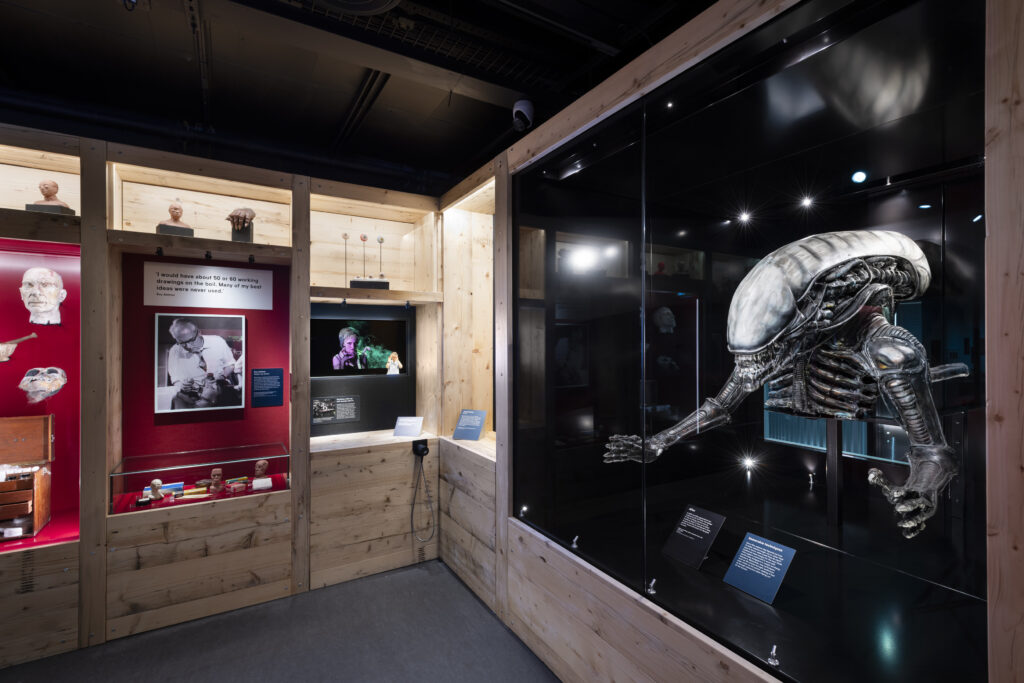
Replica of the Alien from the film Alien, made by Exquisite Corpse, England, c.1990. Science Museum Group Collection
Developing a biomechanical style
Born in 1940 in Chur, Switzerland, from a young age Giger developed a strong passion for all things surreal and macabre. This, along with his strong imagination and need to express himself, naturally led him to consider visual arts as a profession. His father, a pharmacist, viewed art as a ‘breadless profession’ and strongly encouraged his son to pursue a career in pharmacy.
In 1962, Giger moved to Zurich to study architecture and industrial design and began producing his first ink and oil paintings in 1964. This resulted in his first solo exhibition, swiftly followed by the publication and distribution of his first poster series. Shortly after, Giger discovered the airbrush, and along with it, his unique freehand painting style for which he is recognised today.
This biomechanical art style is synonymous with Giger’s work, but what exactly is it? In short, it is a surrealist style of art that combines mechanical and organic materials and renders them with a distinct realism, resulting in hybrid forms that often depict something other-worldly, dreamlike or futuristic. This strange aesthetic goes beyond the fantastical into something that is both magical and unsettling in equal measure. It is these elements that are central both to Giger’s work as a whole and the creation of the most iconic sci-fi horror monster.
The influence of surrealism
Surrealism is more than just a style, it’s a rebellion. Surrealist artists believed that our everyday, rational view of the world was incomplete. They wanted to tap into something deeper and more powerful: the unconscious mind and our dreams. André Breton, the movement’s leader, famously defined it as ‘pure psychic automatism’, which basically means letting your mind wander without any logic or rules getting in the way.
Within the surrealist movement there was something of a ‘style war’, with artists like Salvador Dalí and René Magritte painting their dream worlds with photorealistic detail with the aim of making the impossible look completely and disturbingly real. Other artists like Joan Miró and Yves Tanguy took the opposite approach, using abstract blob-like forms that looked like bizarre, imaginary organisms, reflecting the fluid nature of the subconscious.
Giger is often linked to Dali’s hyper-realistic style, and it is well documented that he was a huge fan of his work. However, looking closer at Giger’s work reveals that he was actually fusing both of those surrealist styles to create something new. Using incredibly precise air brush techniques to depict his grotesque organic shapes, he perfectly combined Dali’s meticulous skill and Miro’s non-geometric forms.
Exorcising nightmares through art
Giger’s artwork was deeply rooted in his personal life. He suffered from chronic night terrors and would use his art as a form of therapy to “exorcise the visions” that haunted his nightmares. He would even keep a sketchbook by the side of his bed to quickly capture the “demons” that visited him. This need to turn his fears into something tangible is exactly what the surrealists were about. Giger described his creative process in a way that also sounds similar to the surrealist idea of automatism, stating that when he started a painting he had “no idea what I was doing” and that the images “came from the belly”. It was a spontaneous outpouring of his subconscious mind.
While the original surrealists explored the subconscious world of dreams, Giger was all about nightmares. He felt that the subconscious had a ‘dark heart’ full of primal fears that most people would never confront. His art was a journey into that darkness, applying surrealist methods to reveal a visceral horror that commented on the fears of the modern world.
By 1977, Giger’s work was gaining traction around the world. That year he published Necronomicon, a book showcasing a selection of artworks that would go on to sell thousands of copies and be printed in multiple languages, and it’s within these pages that the origin of the Xenomorph lies.
In 1979, during the early stages of production for Alien, the film’s director Ridley Scott was given a copy of Necronomicon by the screenwriter Dan O’ Bannon. O’Bannon has become familiar with Giger’s work whilst working on an ill-fated Dune project and recalled: “I had never seen anything that was quite as horrible and at the same time as beautiful as his work” – a statement that perfectly sums up a Xenomorph.
Replica of the Alien from the film Alien, made by Exquisite Corpse, England, c.1990, on display in our Sound and Vision galleries.
A terrifying design
Scott immediately saw the potential in Giger’s artwork and the chance to create something truly unique. He chose Necronom IV, a painting Giger had completed in 1976, as the basis for the alien’s design. Looking at this artwork, the similarities with the eventual creature design are clear. The elongated head, the graceful armour-covered body and snarling mouth. However, there is one key difference: this creature had eyes.
Fox were initially wary of allowing Giger onto the project, claiming that his work would be too disturbing for audiences, but eventually they relented. Giger offered to design the alien from scratch, but Scott mandated that he base his work on Necronom IV, saying that to start over would be too time-consuming. Giger signed on to design the adult, egg and chest burster forms, but ultimately designed the alien planet LV-426 and the space jockey vessel too.
Giger conceived of the alien being vaguely human in form, albeit a human covered in armor and protected from all outside forces. He removed the creature’s eyes as he felt it made the creature much more frightening if you could not tell if it was looking at you. A secondary change was the addition of the second inner set of jaws within the alien’s mouth, located at the end of a tongue-like appendage, which quickly extends to be used as a weapon.
The lack of eyes on the creature completely removes that familiar feeling we have when we come face to face with monsters. We can’t read the creature, making it much harder to understand its intentions. Pair this with its sheer strength, the camouflage of its dark body among the shadows of the ship, the imposing size and freakish ability to move so quietly despite that, and you instantly have the recipe for a truly unnerving creature that you certainly don’t want chasing you down on a stranded spacecraft. It perfectly embodies the apex predator toying with its prey, only giving itself away with excessive salivating when close to its victims. And let’s not forget that when you hurt it, its blood is acidic. Now that hardly seems fair. The design makes the creature hard to understand biologically, again taking us one step further away from any creature we might be familiar with. There’s something, well, alien about it.
The replica alien on display in our Sound and Vision galleries
It’s clear that the alien’s design stays true to Giger’s core philosophies and aesthetics, perfectly encompassing the biomechanical style. But while it is easy to focus on the terrifying nature of the xenomorph’s design, credit must be given to the earlier stages of its lifecycle. A great example of this is the ‘face hugger’ which encapsulated that claustrophobic and violating feeling that the film creates.
The face hugger was actually the first element that Giger designed for the film. O’Bannon had sent Giger about $1000, along with some descriptions and rough drawings explaining the concept of the film, and stated that the creature Giger made would be jumping out of an egg. Horrifyingly, Giger’s original concept for the face hugger was much bigger, with eyes and a coiled, spring-like tail to help it jump onto its prey. After feedback he made it smaller and more similar to a human hand as he felt it would be scarier-again playing with the surrealist idea of the uncanny (something being familiar but not quite) with its long, spider-like fingers that allow it to grab onto its victim’s head.
So there you have it: H R Giger’s designs for Alien weren’t just good, they were transformative, bleeding through the screen into our subconscious and forever changing what we expect from cinematic horror. The Xenomorph isn’t just a monster; it’s a living nightmare sculpted from the fears of its creator. A fever dream of surrealist art that was brought to life. His work elevated Alien from a simple sci-fi creature feature into a true masterpiece of atmospheric horror. As Dallas famously says: “I’ve seen some goddamn strange things in my time, but this…this is a new one”.
The Essex director came out swinging with his 2009 debut: a tale of a man who, on the return to his Brighton home after release from prison, decides to find the rat in his criminal organisation. A tale of recrimination, betrayal and murder ensues.
Roots in traditional kitchen-sink drama slowly erode into something grotesque and twisted over a tight 90 minutes, laying the groundwork for Wheatley’s future preoccupations with family, horror and the occasional bad trip.
Kill List (2011)
Part social realism, part folk horror, Kill List follows Neil Maskell’s soldier-turned-hitman Jay as a new job leads him down a sinister path.
Light on plot and heavy on nightmarish imagery, Wheatley produces some of his most arresting work here, taking cues from Get Carter, The Wicker Man, Ken Loach and The Blair Witch Project to create of one the most unique British films of this century.
Sightseers (2012)
Surely one of Wheatley’s most accessible titles, Sightseers is a delightfully twisted romp through the British countryside with couple Chris and Tina (Steve Oram and Alice Lowe).
Sightseers
Their plans for a peaceful break in their caravan quickly turn murderous when they begin offing everyone who annoys them, culminating in a spectacular showdown at the Ribblehead Viaduct.
Nominated for seven BIFA awards and winning for Best Screenplay, we recommend Sightseers as a lighter take on Wheatley’s work.
A Field in England (2013)
Back to folk horror then, and A Field in England, in which a 17th century group descends into a chaos of fighting, arguments and paranoia as they search for treasure.
Shot in stark black and white, the film contains some of the most iconic imagery of Wheatley’s career, with a few choice shots still seared onto our brain (you’ll know when you see it.)
High-Rise (2015)
The work of J.G. Ballard has proved tricky to adapt in the past—think of Cronenberg’s provocative Crash, Spielberg’s sprawling Empire of the Sun and a messy adaptation of Atrocity Exhibition, and you’ll see that spinning Ballard’s speculative sci-fi and sharp satire into a full-blown feature can drive a filmmaker mad—but not Ben Wheatley.
His dystopian take on the author’s prescient novella weaves together glitz, grime and an ABBA needle-drop to produce one of 2015’s best films.
Free Fire (2016)
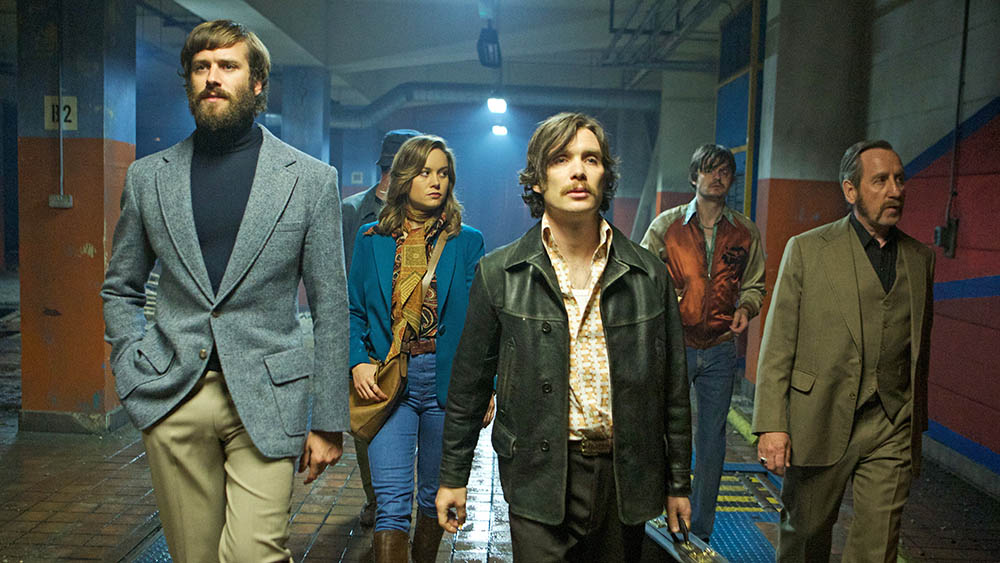
A warehouse, a deal gone wrong and a bloody shootout. Sometimes the best films take a simple hook, cast your favourite stars and let it rip.
Free Fire
Featuring future Oscar winners Cillian Murphy and Brie Larson alongside some of Wheatley’s usual players, the film’s initial look of a Reservoir Dogs spoof descends into something much stranger and farcical (we’d expect nothing less from this director) as mishap after mishap conjures up 90 minutes of mayhem.
Happy New Year, Colin Burstead (2018)
A change of pace for the next one, as the high-octane action Free Fire was followed up in 2018 with this melancholy winter entry. Reteaming with Kill List star Neil Maskell in the lead role, the film tells the story of Colin Burstead, who rents a country house for his eccentric family to celebrate the new year.
With a packed ensemble of incredible character actors including Charles Dance, Hayley Squires and BULK star Sam Riley, the film can in fact be seen as a spiritual successor to Free Fire—we sit back at watch through our fingers as a group descends into chaos.
Rebecca (2020)
There aren’t many directors bold enough to tackle Hitchcock, but, if you hadn’t guessed by now, Ben Wheatley does not do the expected.
This 2020 remake is a lavish Gothic Romance starring Lily James and Armie Hammer, finding a fresh twist on a classic tale of revenge and woe.
In the Earth (2021)
This surreal kaleidoscopic horror taps into pandemic neuroses with razor-sharp precision.
Conceived during the first few weeks of COVID and shot with a small crew over summer 2020, In the Earth finds Wheatley making sense of uncertain times with familiar preoccupations—expect hallucinogens, folk horror and his old friend Reece Shearsmith in a terrific turn.
Meg 2: The Trench (2023)
The natural extension of a director so occupied with deconstructing genre, Meg 2: The Trench finds Wheatley at his most playful, with campy thrills and a great comic role for our chiselled hero Jason Statham.
Vanity Fair dubbed it “Bigger, Sillier and Better” than its predecessor, and we recommend making it a madcap midnight movie night with some pals.
BULK (2025)
While much remains under wraps about Wheatley’s enigmatic next feature, we’ve heard rumours it’s a pulsating, genre-hopping thriller that brings him back to those twisted roots of the early 2010s.
BULK
Ben will be joining us along with actors Sam Riley and Alexandra Maria Lara and producer Andy Starke for a Q&A and screening of BULK on 16 August, fresh from its world premiere at the Edinburgh International Film Festival, and it’s set to be a night to remember.